Before I begin to commence (think about that and I guarantee you, you will become a headache on legs), as background.
Everyone reading is more or less familiar with the notion of "living museums". Williamsburg Virgina is such a place, and, possibly, the best known. But there are other places scattered throughout the country, as well. Some are small, some are large. They all bring the visitors' focuses (foci? focaacia? Oh dear..it's only the second paragraph) to a time not in the "now". Sturbridge Village, the Plymouth Plantation...and Genesee Country Village and Museum (GCV)
Fortunately (for me) or unfortunately (for you!), GCV is a mere 26 minute drive from my humble hobbit hole in Greece, NY. I have loved going there for decades (yeah, so I'm sligihtly older than 30...) and have watched it grow all that time.
The Genesee River (after which the beer is named) flows North from the Southern Tier toward Lake Ontario. (Remember, in this case, North is a lower altitude than South). As it wends or thunders or tiptoes its way (and we've seen pics of the river raging through downtown) it has provided water, transport, power, and some nifty geology to the people who have setted in the region.
Here are a couple of shots of the river. The first is Middle Falls and Upper Falls in Letchworth State Park, south of Rochester.
And we all remember the pictures of the river rampaging through at Broad and Court Street Bridges in downtown Rochester.
Colonel Nathaniel Rochester acquired 100 square acres of land (someone should take a look at land acquisitions and such during the settlement period. It's enough to make a body's head spin widdershins!), which was named Rochesterville in 1817. In 1821, when Monroe and Wayne counties were formed, Rochesterville became the county seat. Don't ask. I don't think they sat down any more than anyone else, really!
In small towns and hamlets all around Rochesterville, other settlers were claiming land and starting new lives. Some of the towns are still in existence; some are not. People were farmers and teachers, ministers and tavern owners, land agents and insurance reps (yup, even back then.).
And, for the next couple of hundred years (well, I'm only going as far as the timeline for GCV goes), the area continued to change and to grow.
Buildings had to be constructed to be TOUGH, and I don't mean maybe. Exterior painting of homes wasn't common until into the 19th century, so the wood from which homes were built was exposed to our charming humidity and heat in the summer, rain and sleet and snow all the other three months, and the occasional storm or flood. Not surprisingly, a number of buildings from centuries past survived or at least managed to hold themselves upright well into the 20th century.
Which is where our story begins.
I could go on forever, but I'm not going to. Jack Whele, a philanthropist and appreciator of the history of the Genesee Valley, purchased 600 acres of land in Mumford, NY in 1966. He had a vision: he wanted to find and move to the village buildings representative of the settlement years of Western New York, focusin on the 19th century, but with some earlier buildings if possible.
Mr. W's feeling was that, just as fine arts represent the culture of a society, so do the crafts (carpentry, husbandry, tin smithing, etc.). He wanted to preserve the history of such things and wanted the public to be able to experience them in an outdoor setting.
That was the beginning.
And this is what it's like today.
I know it's a small map, but - the front gate is near the bottom of the map. The Great Meadow (shades of Bilbo's Birthday Party!) separates the more modern buildings from the village itself. And the old Toll Road Gatehouse is the place to step back into a different era.
Some piccies to give you an idea:
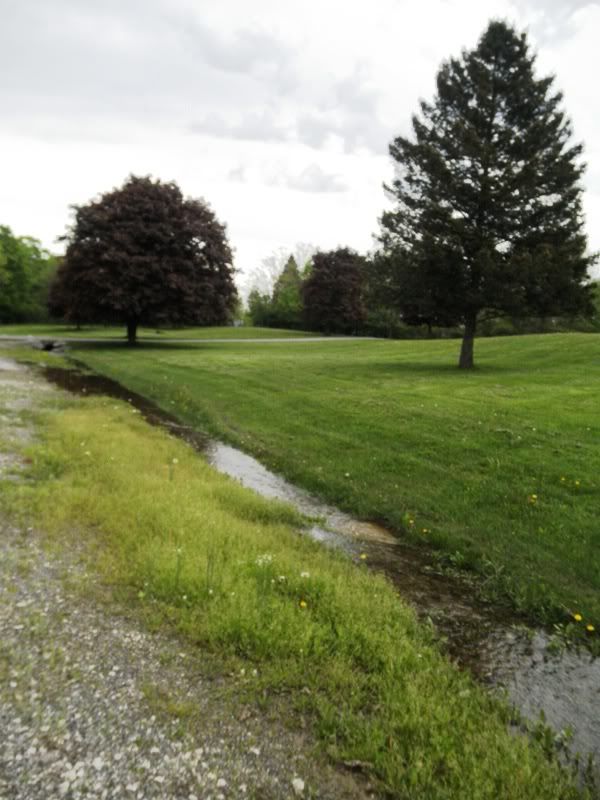
My first visit out was in late May this year, on a grey and cold day. But I still took pictures. The parking lot is behind me. The tiny stream that you see in the picture is actually the result of run off: everywhere was hugely damp this spring!
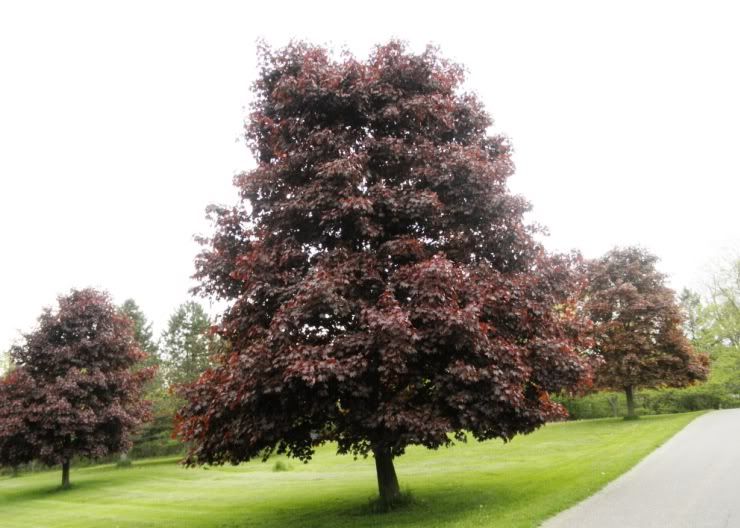
A Red Maple (or is that Oak? Nope, Maple) at the side of the walk up to the entry. I am a tree person so there are lots of 'em...
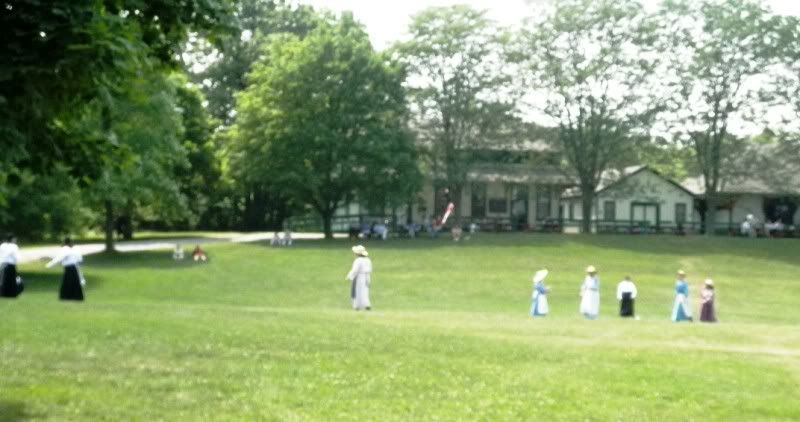
I just looked to see if I'd down shots of the Great Meadow and, other than the one for the Ladies' Baseball Team, I don't have any! Bah! Shame on me! You can see from the map above that there is quite an expanse of space. One can walk around the circumfrance or cut straight across the middle (much preferable). I shall find pictures of the Bandstand the Carriage Museum and The Wehle Art Gallery and post them later.
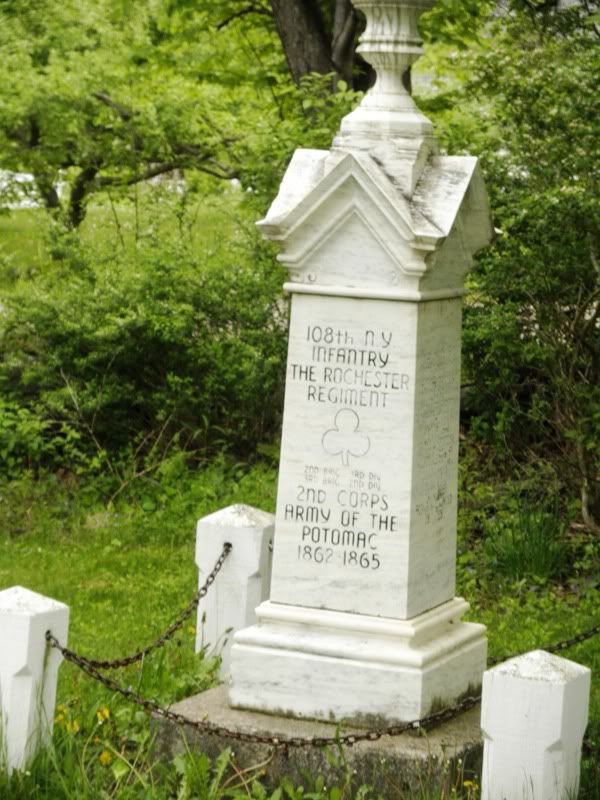
For now: We have reached the Old Toll House. But first, off to the right of the Toll House stands a little monument, set up with care a decade ago and in honor of one of the New York Units that fought in the American Civil War.
I was there that day. It happened quietly and without a lot of speeches or noise. There is inscription on all four sides (and you can see the Great Meadow in the background). This one has the grimmest and most telling message. Mustered in: 1095. Mustered out: 387.
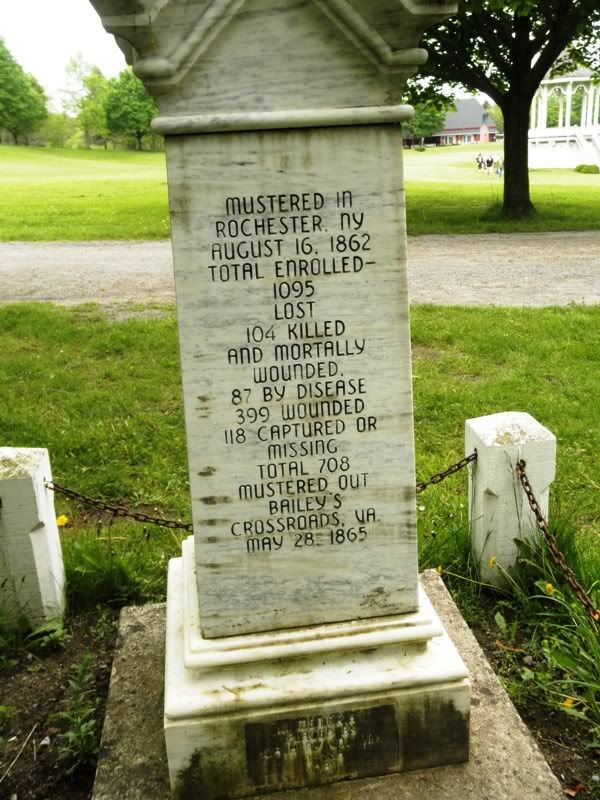
And this is the front.
Still, the statistics and the details are only important as signposts of what effect they might have had on the population living in the Genesee Valley...
People are still respectful and quiet as they walk by this little monument. But they are also excited about entering the village and head straight for the old toll house.
Different day - more SUN!
That's the toll house.
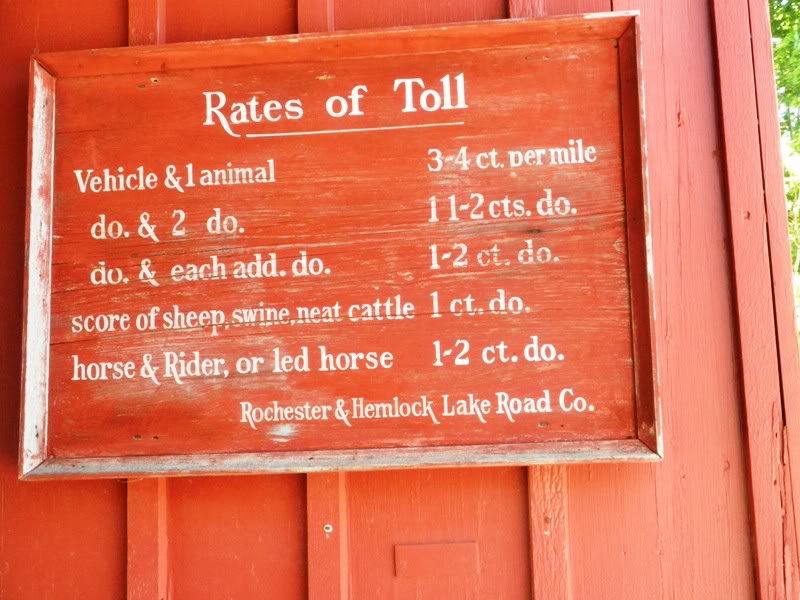
These are the tolls on the Rochester and Hemlock Lake Road Co. Do you see the "do."? That's the 19th century method of writing "ditto" (which we do using a quotation mark). Ct. is, of course, cents. I'm not sure what a cent looked like in the 19th century (I should go look), but they were definitely not the same as the ones today.
The toll keeper lived in the toll house. And it looked like this:
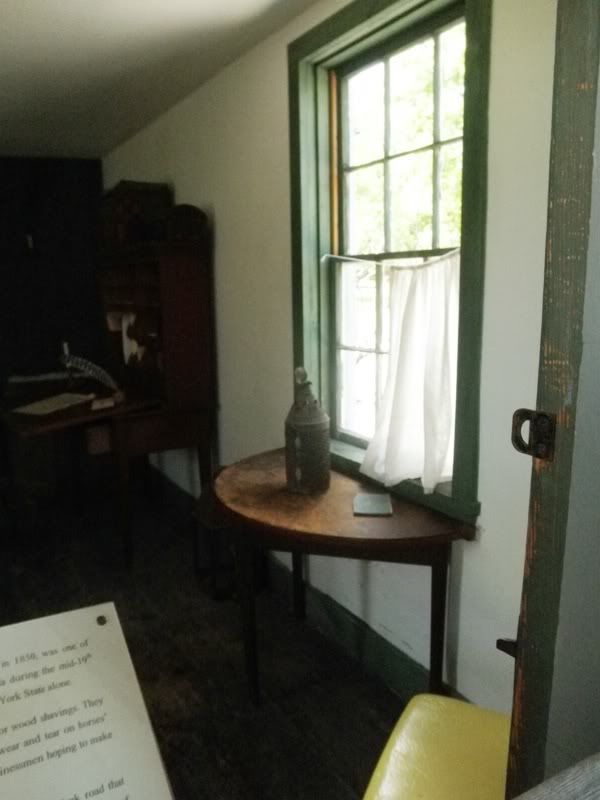
There is a small sleeping room in the back (you can see the door), and the rest of the dwelling consisted of this front area.
This is just to the right of the last picture. In fact, in the lower left is the rest of the explanatory placard describing the building. The curtain rod is a piece of rope (pretty handy), and the chair is upholstered in yellow fabric. Everything here dates back to the period, including the little table under the window.
Once inside the village proper, the question is Which Way to Go???? If you were a traveller in the 19th century, you might want to go to the general store. So that's what we're going to do.
The Altay General Store was moved from Altay New York a distance of 84 miles Northwest to Mumford. In this case, it was moved by truck. The family that owned the store had built their home as an extension of the store, but that was not included in the move...
If you want to locate Altay, draw a triangle among Bath, NY, Penn Yann, Ny and Watkins Glen, NY. Smackin the just below lower center is where the tiny town of Altay is.
Here's the exterior of the store:
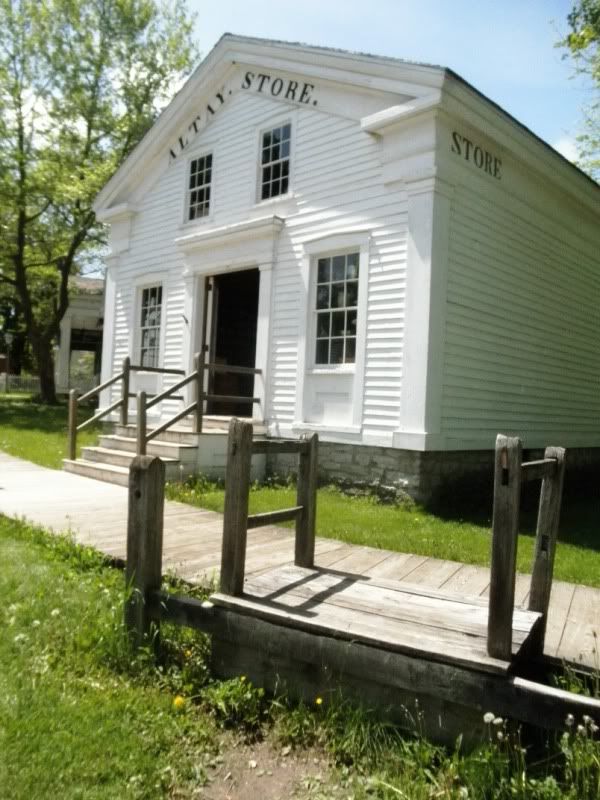
This is the store itself, not a reproduction. As you can see, the sidewalks in front are made of boards. Just wanted to toss that in!
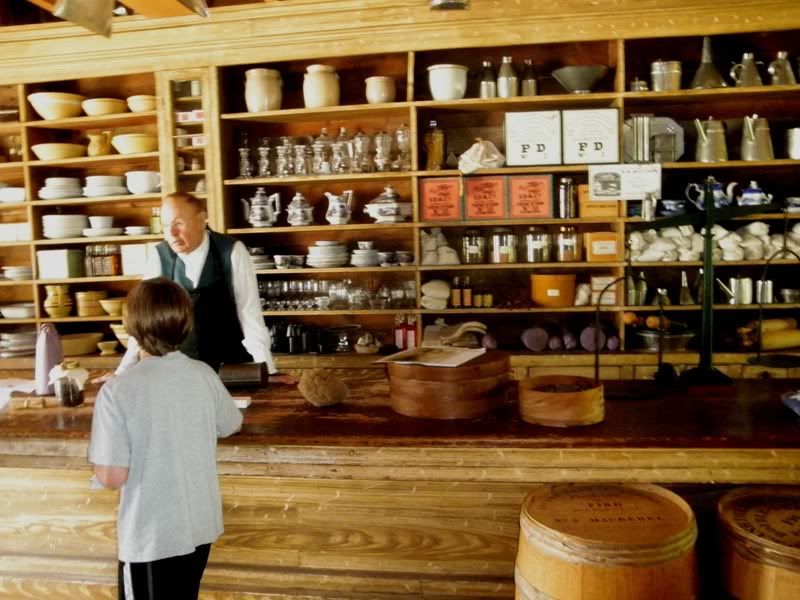
On the day (the sunny one) that I took these pictures, there were children on field trips from nearby schools and the gentleman talking to them kept 'em hopping! His clothing is period dress, made to patterns from the time and in materials common at the time. Everything that you see on the shelves would have been for sale in the Altay Store. Some of the glassware is actually from the early 1800s, although some is reproduction. There is a gorgeous set of brown toile transferware that someone donated to the museum. And there are all sorts of boxes and cans of things.
This is the back of the store, just to the gentleman's left (my right). The cabinet and cases hold everything from gloves (in the glass fronted cabinet in the center, to notions (sewing equipment, guys - you know, needles and thread and that sort of thing) to lamps and up over the range of this picture, chairs hanging from the ceiling beams. To the right is a second long counter (from the store originally as is the one the gentleman is leaning on) and behind that are bolts and bolts of yard goods, baskets, things of that nature.
Oh, and the big rectangular heap in the front is rope. A LOT of rope.
when I first started going to the museum, there were very few things in the store, but, as the years have gone by, more and more types of merchandise have found their way in. This store is actually really full! They need a yard sale! I get to buy first!!!!
And, still relaxing in the pleasant gloom of the General Store, I bid you adiew for now. Next time? Hmmmmmmmm....perhaps the Hosmer Inn and a whole new definition of "underground living"????
Friday, July 8, 2011
Thursday, June 23, 2011
A Little Wander to a Little Corner
Hulloo! This is a blog about a little wander to a little corner of a field that's grown up over the past few years in a spot that I've driven by hundreds of times, I'm sure.
Something like six years ago, a parking lot sized space was cleared next to the Latta/Long Pond Wegmans. Whatever was supposed to happen to it, didn't and, as often happens, the plain dirt was slowly decorated by what people call a "field". It's actually on the West Side of the Frontage Road that connects Wegmans to the Mc Donalds, a day-care center, and the Latta Road brach of Eastman Credit Union (otherwise known as a bank). I'm using the term frontage road because, in the rest of the country, that's what it would be called).
One day a couple of weeks ago, I had several errands to run and decided I'd park my car in a central location and walk to my destinations. As has now become habit, I carried my camera.
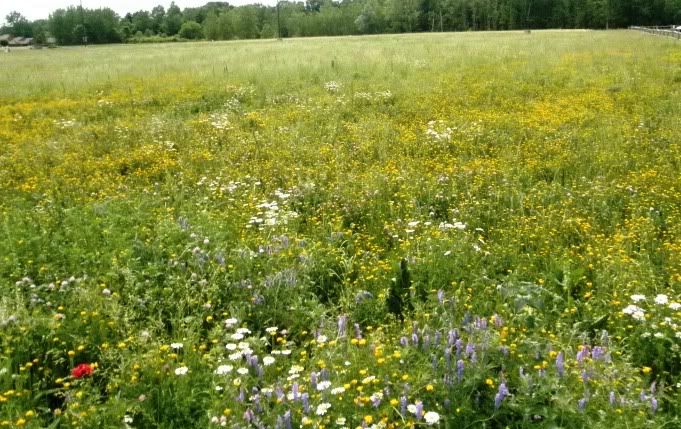
I've driven by this field SOO often and never actually seen it...I want you to see it, as well, just for grins! And because it's kinda neat
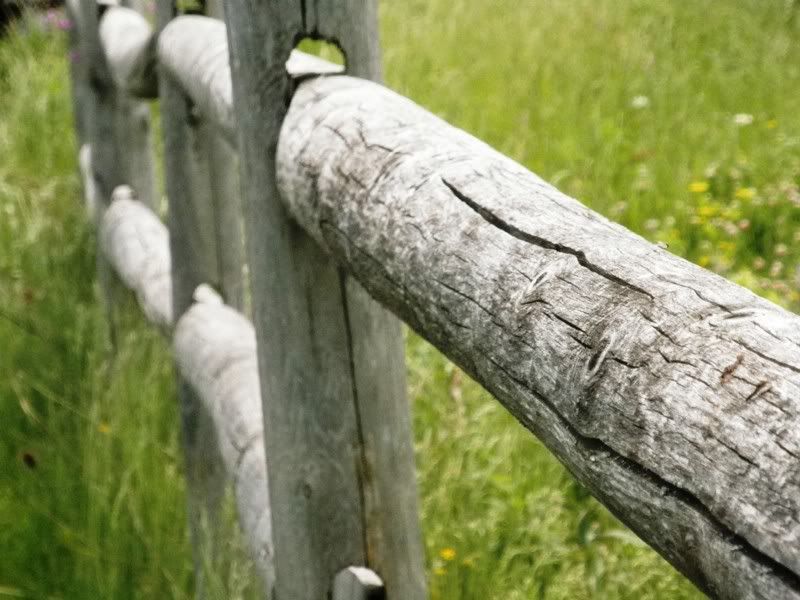
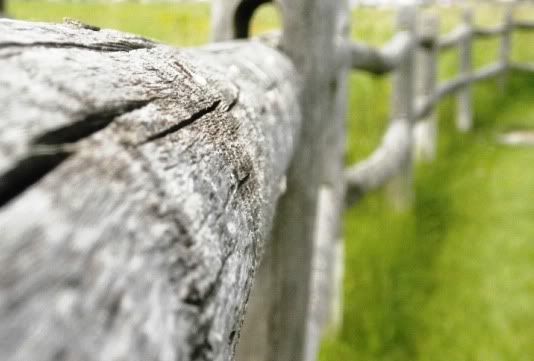
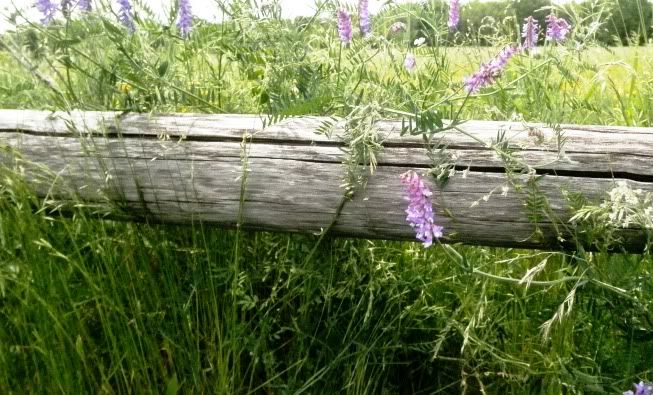
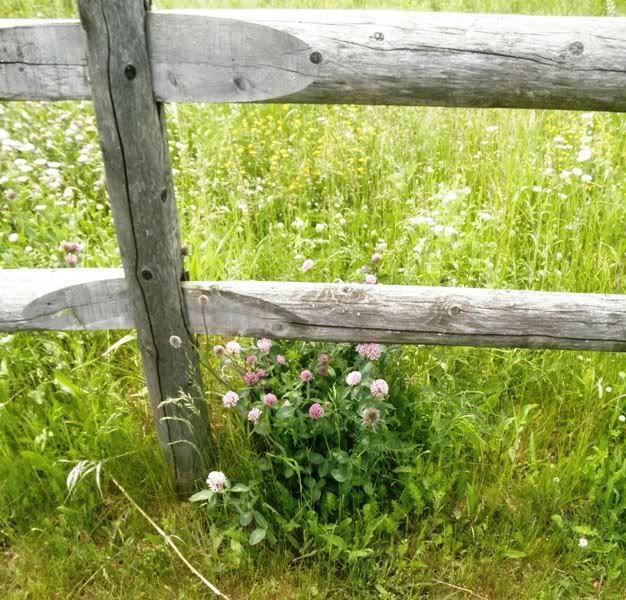
This is the fence that Wegman's put up around the field back when it was supposed to be something else. I like it, so was obliged to take several shots of it, both nekkid and with flowers.
The view a tightrope walking squirrel would have. And me playing with wood grain and all.
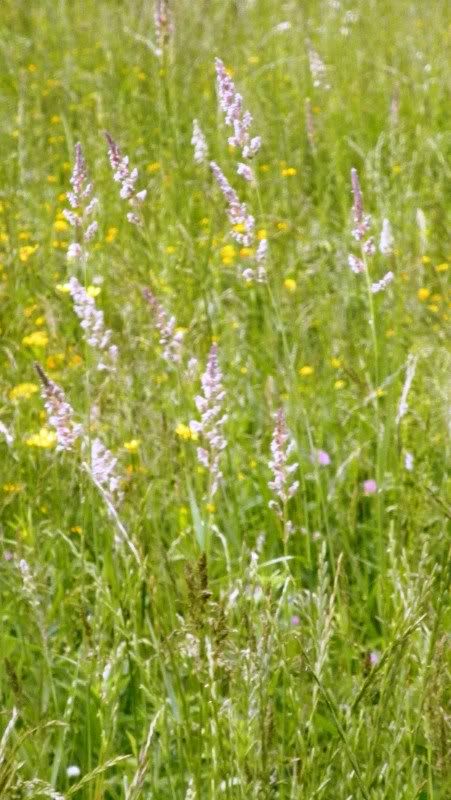
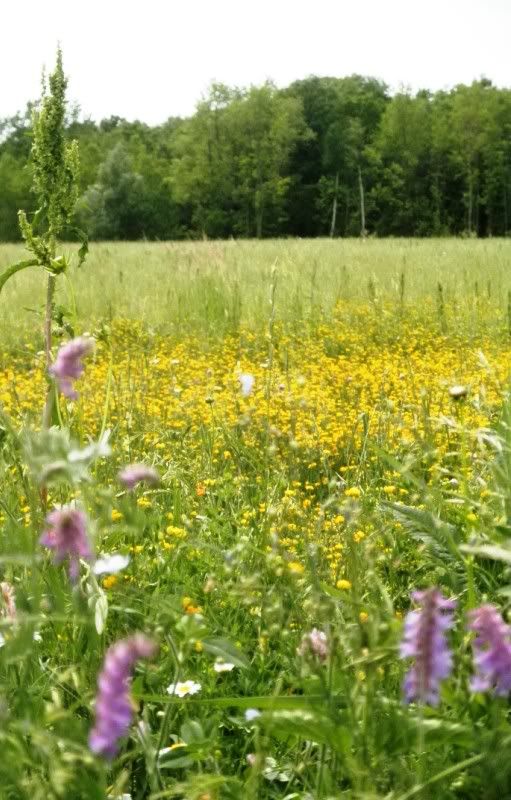
I cropped out my sneaker, which insisted on toeing itself into the bottom of the picture. I took this sitting on the ground. The colors of the little purple flowers were almost irridescent and varied from pinkish purple right on through to purplish blue. Wonderful!!!!
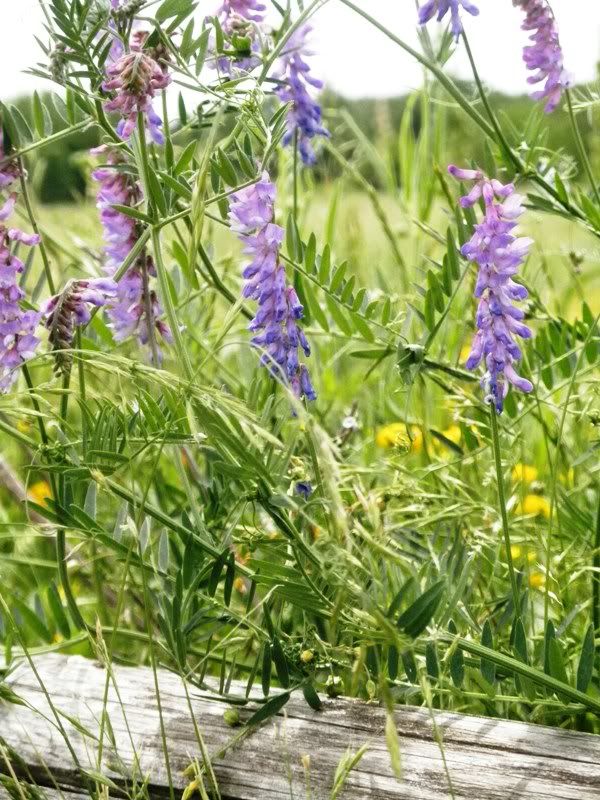
Again from the ground and again the pretty purple flowers. They look a little like mini-foxgloves! The yellow flowers? Dunno, but they were tremendously cheerful to look at !
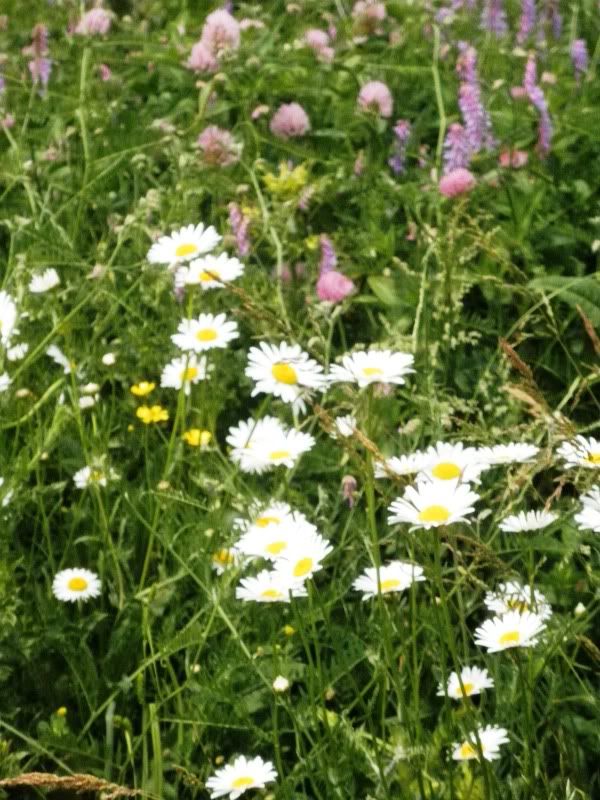
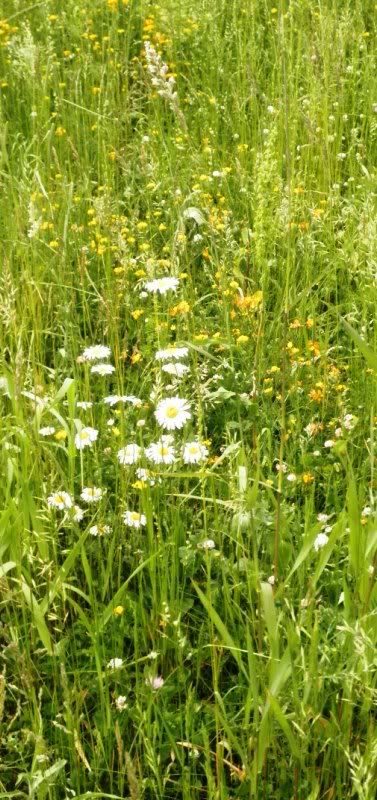
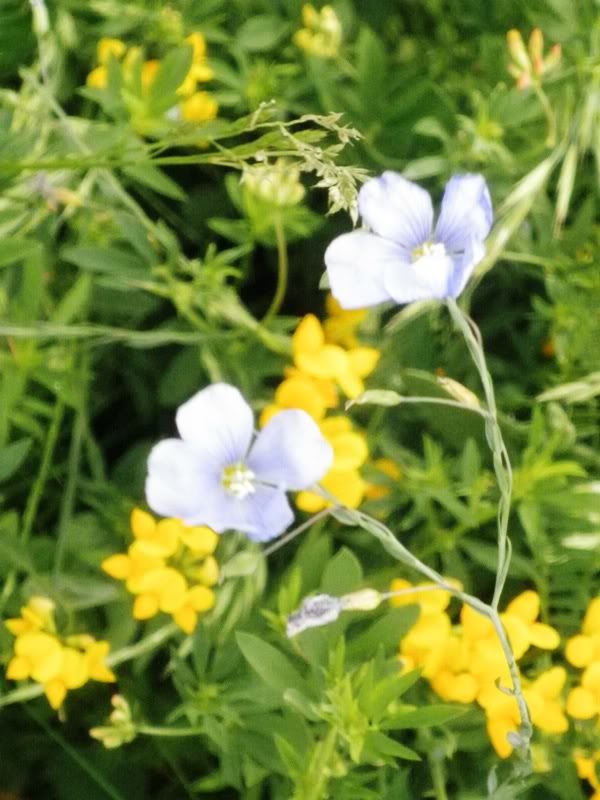
For the most part, these are daisies, I think. The purple flowers in the backgound aren't the same as the ones by the fence, but they're pretty anyway!
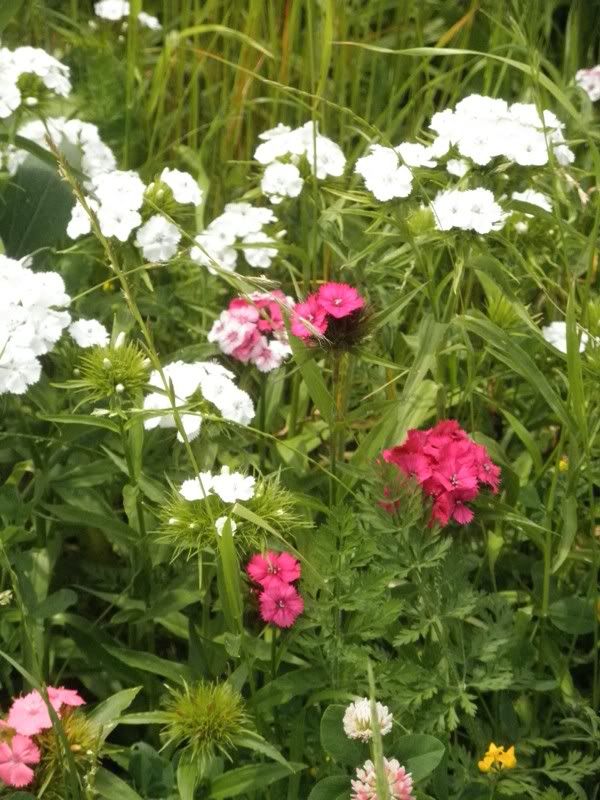
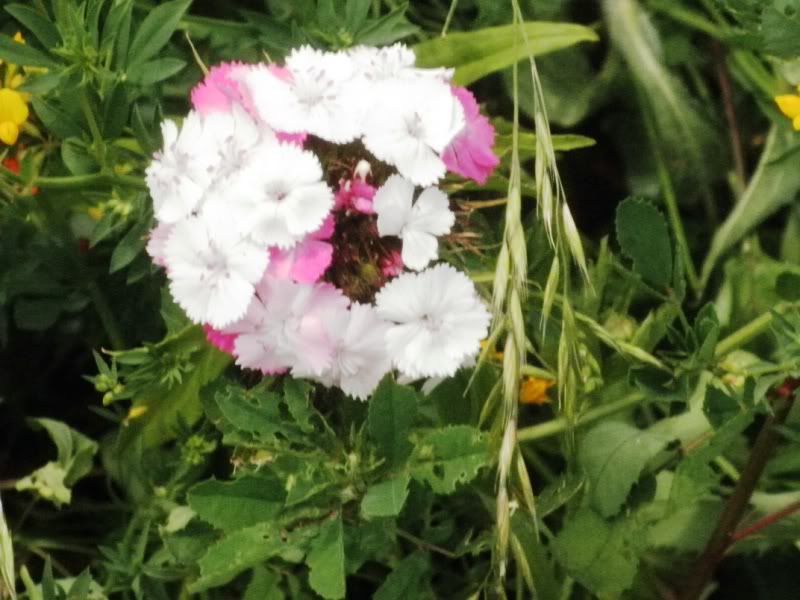
These are pretty (I know - I have to work on my vocabulary). But what interested me the most about them is the way that the colors range from white through to deep pinkish red. The flower in the middle has flowerets that are all diffferent shades of pink, red, and white.
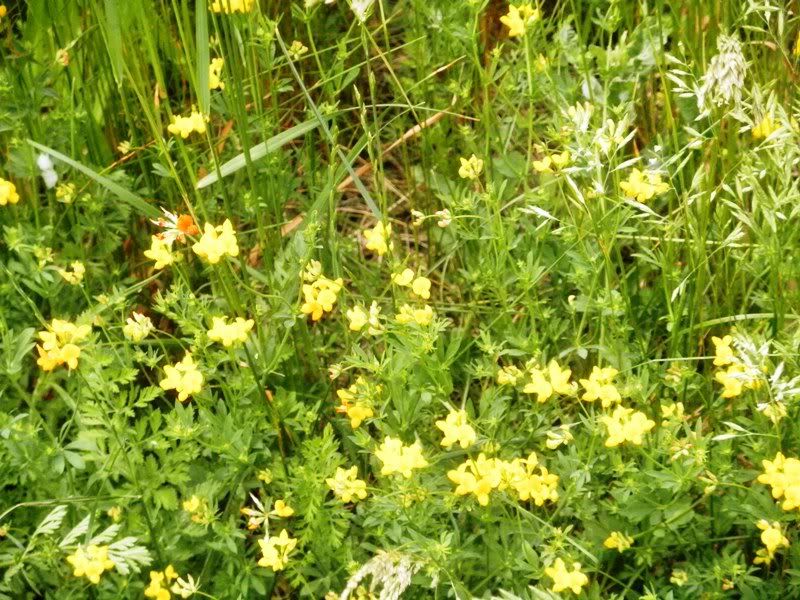
These little yellow guys look like stars!
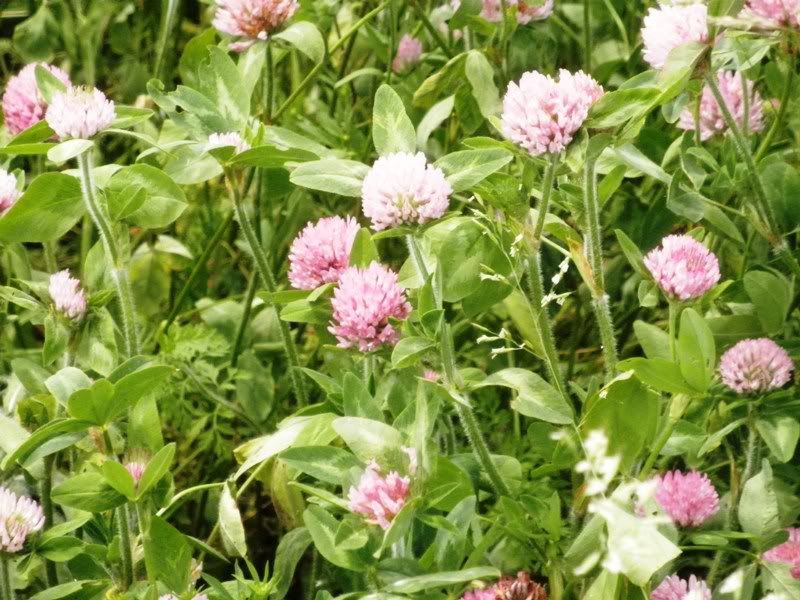
The clover shades from light pink to deeper and then to almost white (color 818 for the counted cross stitchers among us).
And the paler pastels and their stems and leaves add a quiet background of color.
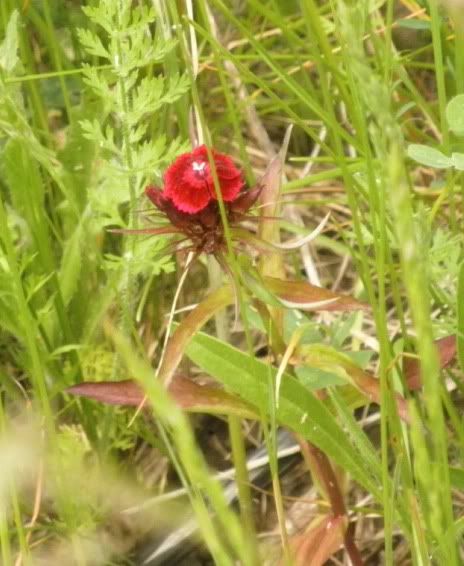
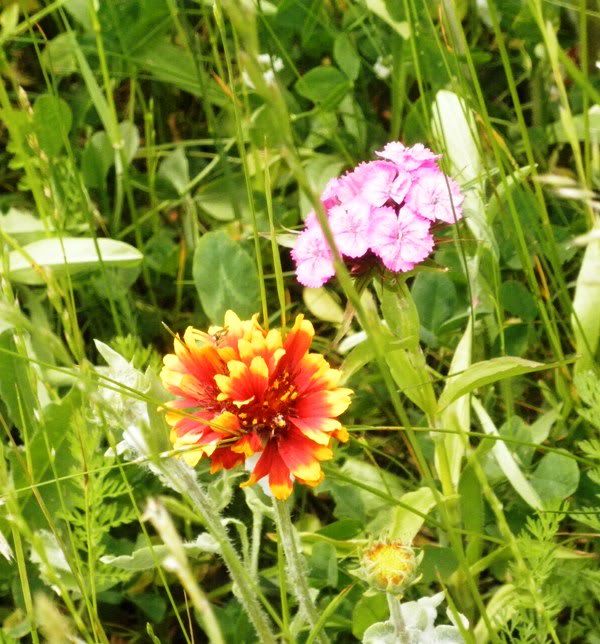
Remember that bright red splotch in the first picture? This is the splotch up closer and more personal. Again, I don't know what it is, but it was BRIGHT!!!!
Each of the little flowerets' petals had ruffled petals. I liked the grass as well. There were so many different green things it was a little overwhelming!
Another bright splotch of color was this flower. I remembered seeing something like it on a web page and went looking. It's a coreopsis. And it seemed to be the only Coreopsis nearby. Perhaps it had pioneered from someone's garden and decided to set up housekeepingg here!
This is just a little wander, a glimpse of a field perhaps an acre in size, on a semi-cloudy day in June in 2011. I'm glad I decided to take that walk from the post office to the bank, or I would have missed seeing this! Keep an eye out, because there's neat stuff all over the place!
Until next time!
Something like six years ago, a parking lot sized space was cleared next to the Latta/Long Pond Wegmans. Whatever was supposed to happen to it, didn't and, as often happens, the plain dirt was slowly decorated by what people call a "field". It's actually on the West Side of the Frontage Road that connects Wegmans to the Mc Donalds, a day-care center, and the Latta Road brach of Eastman Credit Union (otherwise known as a bank). I'm using the term frontage road because, in the rest of the country, that's what it would be called).
One day a couple of weeks ago, I had several errands to run and decided I'd park my car in a central location and walk to my destinations. As has now become habit, I carried my camera.
I've driven by this field SOO often and never actually seen it...I want you to see it, as well, just for grins! And because it's kinda neat
Okay - I just made this bigger. If you'll look carefully in the upper right corner, about 1/4 down from the top? You'll see a little white dot. That is the hood of a car in the parking lot of the store. So we're literally only a few yards from the day-to-day world. And no, that's not a discarded bright red plastic cup down in the lower left. Honest!
Right off the bat (where the heck did that saying come from?), I must apologize for not having the foggiest CLUE what the names of the wildflowers are. Some look like they escaped from a backyard and have decided to go camping in this field. But I have no skill at naming them. Except, of course, to say they're pretty. (I am exceptionally proud of my immense scientific background. Can you tell?)
This is the fence that Wegman's put up around the field back when it was supposed to be something else. I like it, so was obliged to take several shots of it, both nekkid and with flowers.
The view a tightrope walking squirrel would have. And me playing with wood grain and all.
I cropped out my sneaker, which insisted on toeing itself into the bottom of the picture. I took this sitting on the ground. The colors of the little purple flowers were almost irridescent and varied from pinkish purple right on through to purplish blue. Wonderful!!!!
Again from the ground and again the pretty purple flowers. They look a little like mini-foxgloves! The yellow flowers? Dunno, but they were tremendously cheerful to look at !
So, on we go to flowers and greens!
For the most part, these are daisies, I think. The purple flowers in the backgound aren't the same as the ones by the fence, but they're pretty anyway!
These are pretty (I know - I have to work on my vocabulary). But what interested me the most about them is the way that the colors range from white through to deep pinkish red. The flower in the middle has flowerets that are all diffferent shades of pink, red, and white.
These little yellow guys look like stars!
The clover shades from light pink to deeper and then to almost white (color 818 for the counted cross stitchers among us).
And the paler pastels and their stems and leaves add a quiet background of color.
Remember that bright red splotch in the first picture? This is the splotch up closer and more personal. Again, I don't know what it is, but it was BRIGHT!!!!
Each of the little flowerets' petals had ruffled petals. I liked the grass as well. There were so many different green things it was a little overwhelming!
Another bright splotch of color was this flower. I remembered seeing something like it on a web page and went looking. It's a coreopsis. And it seemed to be the only Coreopsis nearby. Perhaps it had pioneered from someone's garden and decided to set up housekeepingg here!
This is just a little wander, a glimpse of a field perhaps an acre in size, on a semi-cloudy day in June in 2011. I'm glad I decided to take that walk from the post office to the bank, or I would have missed seeing this! Keep an eye out, because there's neat stuff all over the place!
Until next time!
Sunday, June 19, 2011
Take Me Out to the Ballgame - 19th Century Style!
Hi, folks! This post is for Lisa and Ron because I took piccies of the baseball field out at Genesee Country Museum yesterday (the season starts today with a double header). Now, remember, this is a league that plays ball back when the game was called base ball (with the space between the two words) and the players wore woolen uniforms and those weird flat topped caps. The field is set up according to the rules that were up and running in the 19th century (the first real rule book came out about 1868).
I noticed that the distance between the pitcher's mound and the plate was much shorter than it is today. And things were a bit more "out in the open". BUT, that being said, it appears that base ball is base ball no matter when.
According to the information on the website and also on a sign at the field, this is the first vintage base ball field (and, of course, the best, but I'm wildly biased) in the nation. There are four local teams who play vistors from other areas in the country.
Here we go!
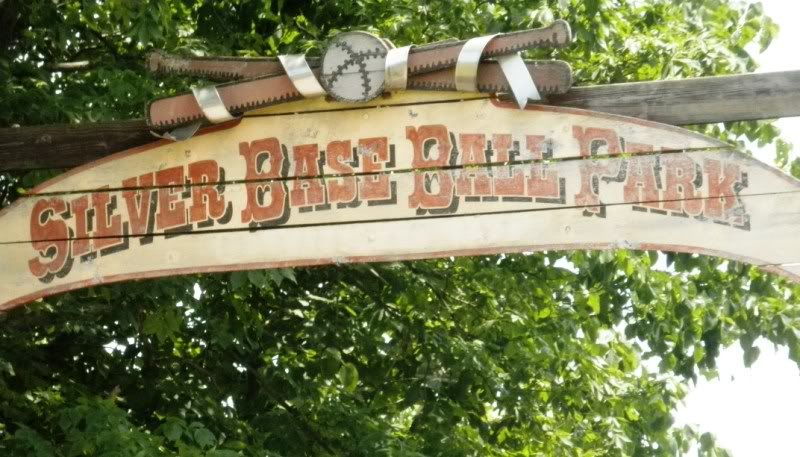
Every Base Ball field has a sign. This is the one for this field.
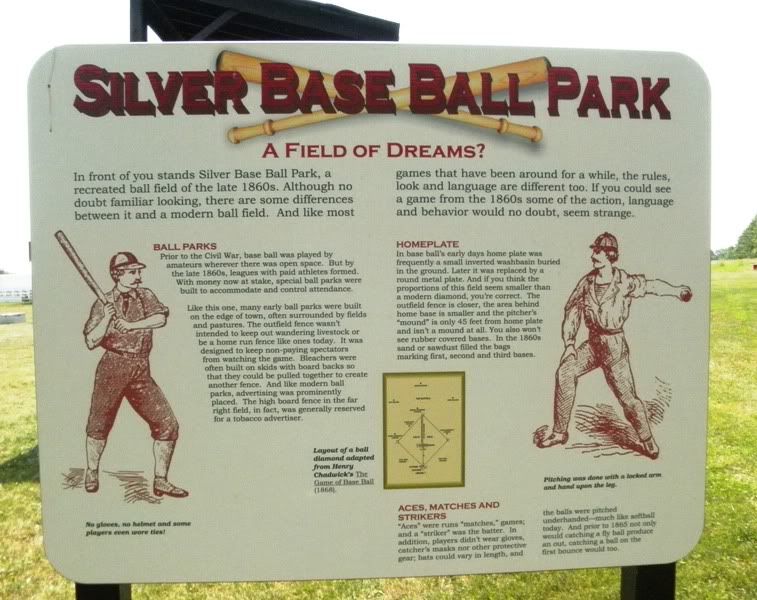
Here is the sign that greets folks as they walk in. It explains a bit about 19th century base ball and shows the layout of the diamond. And, yes, there were folk who played wearing ties. Don't ask - I have no idea what would have been going through their heads!
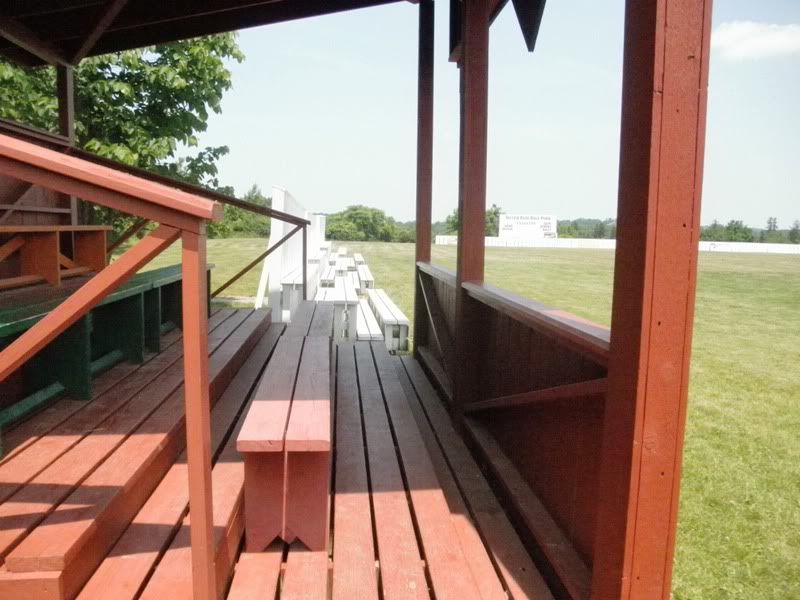
And here is the obligatory artsy shot, this one is looking through the box seats down the 3rd base line including the bleachers.
Yes, it's a field. Very definitely!
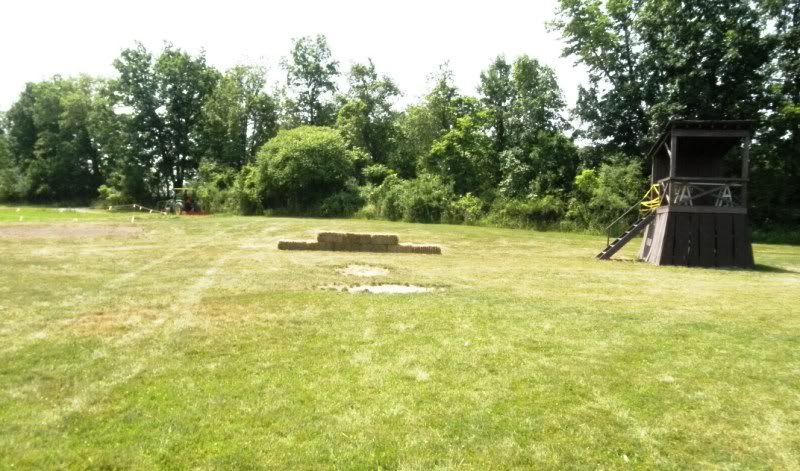
I decided to take shots from the pitcher's mound. From my vantage point, the pitcher's mound didn't seem very high. But all is relative, I suppose!
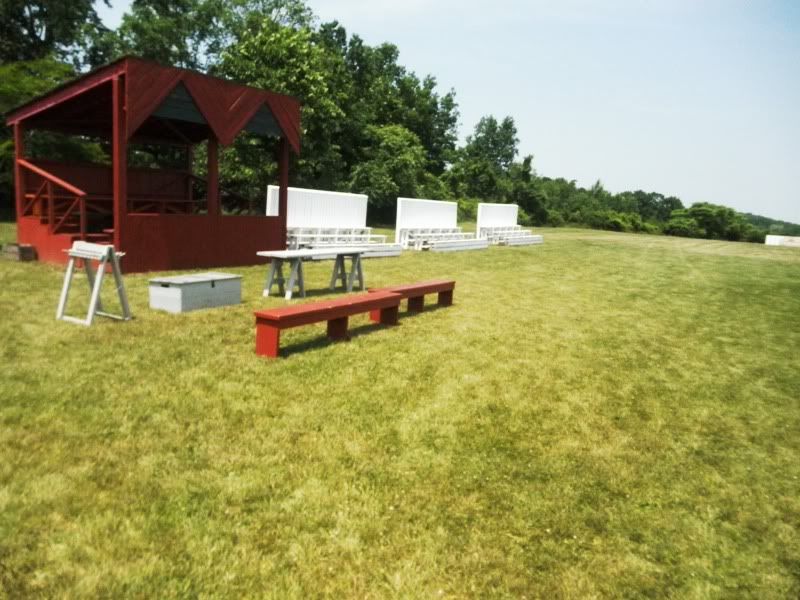
This is the box where the referees sat. To the right are the bleachers and box that I showed in the first picture. To the left is the whatchamacallit - the backstop, maybe? The red bench in between the ref's box and the covered bleachers is the team bench.
I've stepped back away from the mound to get a shot of the entire backstop. And whoever said hay bales were just for storing sileage? Not I!!!!
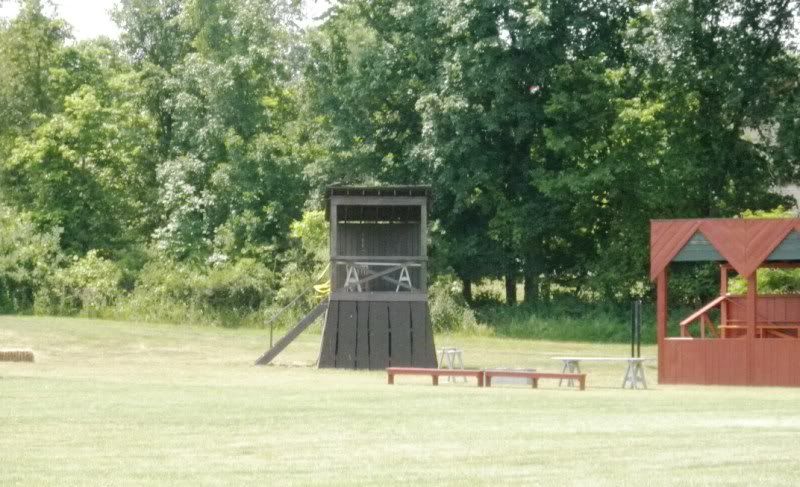
This is the scoreboard. When a game is being played, one or two young people change the information as it mounts up. I think it's pretty neat (but that's just me).
This is a better look at the players' bench. The box behind the bench carries the team's equipment. The table on the sawhorses could have been used for water buckets or perhaps to take a look at an injured player...I'm not sure. But the stand on the near side of the bench held the bats during the game. (Can you tell I'm not really a huge base ball fan? But I am a huge fan of the history of things!)
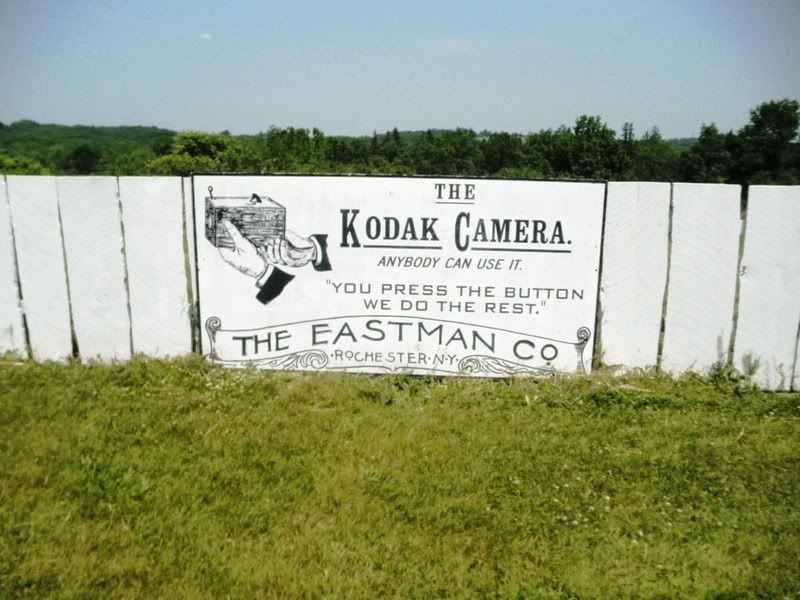
There were ads on the fence, of course (ads have been on things since people have built buildings and decided to do exterior decorating!). The camera that this ad is talking about (just for grins and giggle) is a very early Kodak camera, before the Brownie. In Kodak's first years, one purchased the camera loaded with film. When the film was used up, the entire entity, camera, film and all was returned to Kodak. The camera was reloaded and sent back to its owner. I know that sounds rather odd, but some years were to pass before the film came in a format that the customer could handle without damaging the negatives.
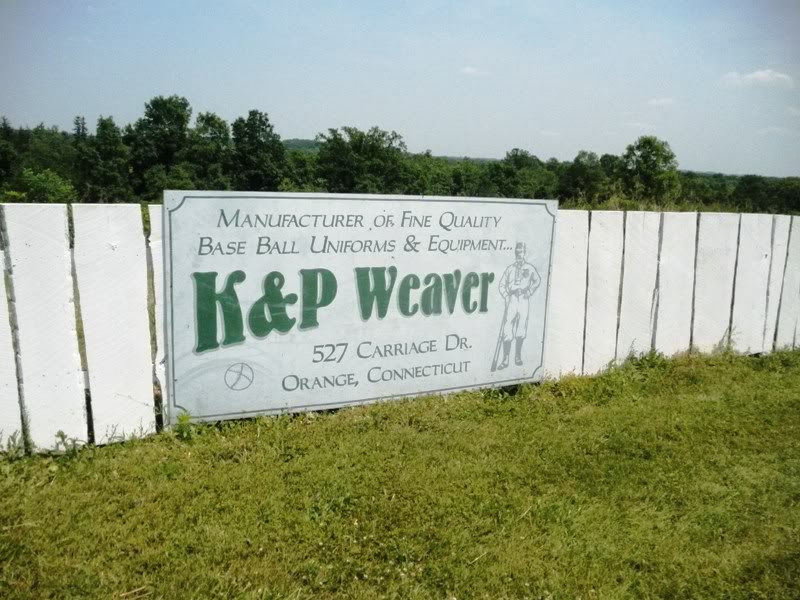
There was a Wendy's sign as well, but, although the format was distinctly 19th century (no little Pippi Longstocking look-alike). I decided, instead, to show this sign. Again, it is definitely the way a sign would have looked in the 19th century, but it's modern. I believe that K&P Weaver is the company that makes the old fashioned uniforms used by heritage teams.
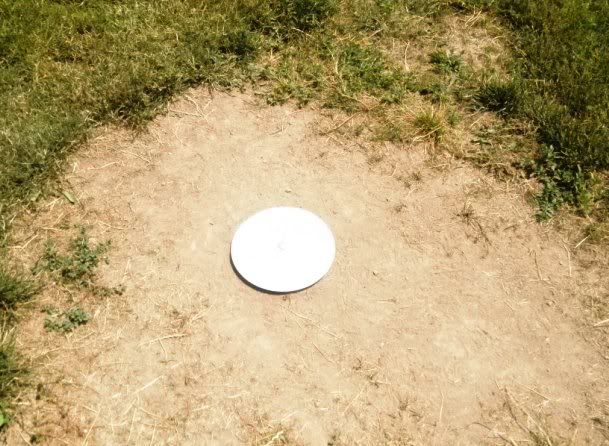
It's a field, there are no line strips and I couldn't figure out where the bases were (although, since today is the first day of the season, perhaps the team hadn't put out whatever markers it uses for the bases), and the players are going to be warmer than the weather even before they start playing. But the game will be a base ball (baseball) game like any other, right down to this day. There will be hawkers vending their wares, homeruns will be hit and everyone will have a great time!
OH, one other picture - and this is a part of history that isn't as well known, I think.
There is a women's 19th century base ball team at the Museum. I am just back from doing some research because I wasn't aware that women DID play ball in the 1800s. However,they most certainly did.
As you might expect, women played out of the public eye for the most part in the early years: playing base ball, like the acting in the theatre, was viewed as marginally acceptable by the public. But play they did.
Here's a URL for more information about that time frame. It's from the Historical Society of Pennsylvania.
http://www.hsp.org/node/2934
Yesterday, they were playing on the Great Meadow (where the bandstand is) at the Museum. And their excitement over the game was contagious. This is a long shot, but I wanted to get a picture of the ladies in as well.
I wish I could have gone to the double header today, but at least I got a chance to see the field and to take some pictures! I hope you liked what I did!
Have a great day!
I noticed that the distance between the pitcher's mound and the plate was much shorter than it is today. And things were a bit more "out in the open". BUT, that being said, it appears that base ball is base ball no matter when.
According to the information on the website and also on a sign at the field, this is the first vintage base ball field (and, of course, the best, but I'm wildly biased) in the nation. There are four local teams who play vistors from other areas in the country.
Here we go!
Every Base Ball field has a sign. This is the one for this field.
Here is the sign that greets folks as they walk in. It explains a bit about 19th century base ball and shows the layout of the diamond. And, yes, there were folk who played wearing ties. Don't ask - I have no idea what would have been going through their heads!
And here is the obligatory artsy shot, this one is looking through the box seats down the 3rd base line including the bleachers.
Yes, it's a field. Very definitely!
I decided to take shots from the pitcher's mound. From my vantage point, the pitcher's mound didn't seem very high. But all is relative, I suppose!
This is the box where the referees sat. To the right are the bleachers and box that I showed in the first picture. To the left is the whatchamacallit - the backstop, maybe? The red bench in between the ref's box and the covered bleachers is the team bench.
I've stepped back away from the mound to get a shot of the entire backstop. And whoever said hay bales were just for storing sileage? Not I!!!!
This is the scoreboard. When a game is being played, one or two young people change the information as it mounts up. I think it's pretty neat (but that's just me).
This is a better look at the players' bench. The box behind the bench carries the team's equipment. The table on the sawhorses could have been used for water buckets or perhaps to take a look at an injured player...I'm not sure. But the stand on the near side of the bench held the bats during the game. (Can you tell I'm not really a huge base ball fan? But I am a huge fan of the history of things!)
There were ads on the fence, of course (ads have been on things since people have built buildings and decided to do exterior decorating!). The camera that this ad is talking about (just for grins and giggle) is a very early Kodak camera, before the Brownie. In Kodak's first years, one purchased the camera loaded with film. When the film was used up, the entire entity, camera, film and all was returned to Kodak. The camera was reloaded and sent back to its owner. I know that sounds rather odd, but some years were to pass before the film came in a format that the customer could handle without damaging the negatives.
There was a Wendy's sign as well, but, although the format was distinctly 19th century (no little Pippi Longstocking look-alike). I decided, instead, to show this sign. Again, it is definitely the way a sign would have looked in the 19th century, but it's modern. I believe that K&P Weaver is the company that makes the old fashioned uniforms used by heritage teams.
It's a field, there are no line strips and I couldn't figure out where the bases were (although, since today is the first day of the season, perhaps the team hadn't put out whatever markers it uses for the bases), and the players are going to be warmer than the weather even before they start playing. But the game will be a base ball (baseball) game like any other, right down to this day. There will be hawkers vending their wares, homeruns will be hit and everyone will have a great time!
OH, one other picture - and this is a part of history that isn't as well known, I think.
There is a women's 19th century base ball team at the Museum. I am just back from doing some research because I wasn't aware that women DID play ball in the 1800s. However,they most certainly did.
As you might expect, women played out of the public eye for the most part in the early years: playing base ball, like the acting in the theatre, was viewed as marginally acceptable by the public. But play they did.
Here's a URL for more information about that time frame. It's from the Historical Society of Pennsylvania.
http://www.hsp.org/node/2934
Yesterday, they were playing on the Great Meadow (where the bandstand is) at the Museum. And their excitement over the game was contagious. This is a long shot, but I wanted to get a picture of the ladies in as well.
I wish I could have gone to the double header today, but at least I got a chance to see the field and to take some pictures! I hope you liked what I did!
Have a great day!
Tuesday, May 24, 2011
Rochester is WATERY!!!!!
Yesterday, we visited a wonderful place (thank you again, Karen!) in England and had a lovely day of it!
Today I'm visting right here at home.
One of the things that people love to talk about (complain about, nag about, you name it) is the weather. Everyone has it, of course. And this spring, it's been a nightmare to many places in the United States.
Rochester had the wettest April on record this year, and May hasn't been a great deal more fun. But we're tough, we are and we keep going. And thanking our lucky stars that all we have to deal with is ice storms, blizzards, cold snaps and the occasional humid thundery summer. Yes, we get tornado action, but nothing like the Midwest.
With that said, I thought it might be fun (I have a VERY strange sense of humor) to take a look at wetness around Rochester.
The Genesee River runs right through Rochester on its way to Lake Ontario. Lake Ontario is the smallest (I kid you not) of the five Great Lakes (Quiz: Name 'em! Can't? Remember the acronym: HOMES: Huron, Ontario, Michigan, Erie, and Superior. The biggest? Superior: it's 350 miles long. The shallowest? Erie: which is a woeful thing when the winter winds begin to blow across it.)
Lake Ontario is only 193 miles long and 53 miles wide at its widest point. Lake Erie is 210 miles by 57 miles. Lake Michigan is 307 miles long and 118 miles at its widest. Lake Huron is 206 miles long by 152 miles wide, but has the longest shore length (Quiz: Why?) Lake Superior is 350 miles long by 160 miles wide.
This spring, the effects of the winds and rains have been moderately spectacular. Lets start with Cranberry Pond on a very windy day.

This is a very sketchy map of Lake Ontario near where I live in Greece. As you can see, there is a series of small ponds across from the larger mass of Lake Ontario. Actually, homes exist on the narrow white band right at the edge of the lake. I'm telling you that just to give you an idea of the lay of the land.
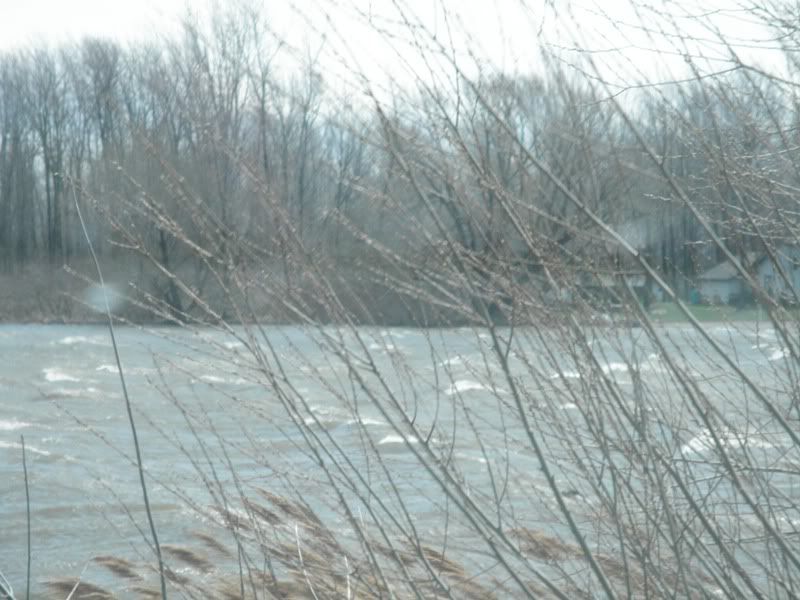
Find Cranberry Pond. This is what Cranberry Pond looks like on a day when the winds are blowing from the Southwest toward the Lake. Ontario, by the way,is calm as it can be at the same time Cranberry Lake looks like this:
Those would be white caps. I actually stayed in the car to take most of my pictures because I felt like I was blowing over when I ventured outside!
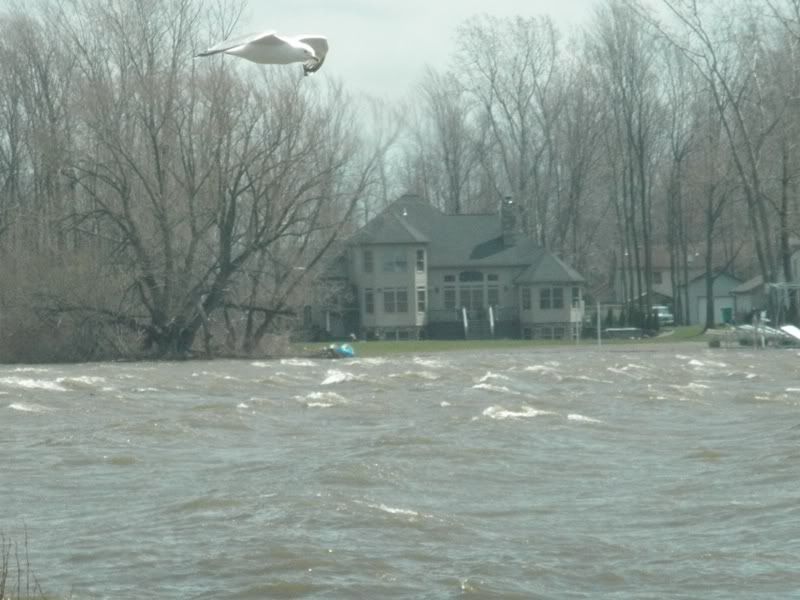
This is a ringbilled seagull attempting to land on the pond during a windstorm. Eventually, he decided to fly with the wind and land across the street (which is behind me, as I had pulled off the road) where things were somewhat quieter.
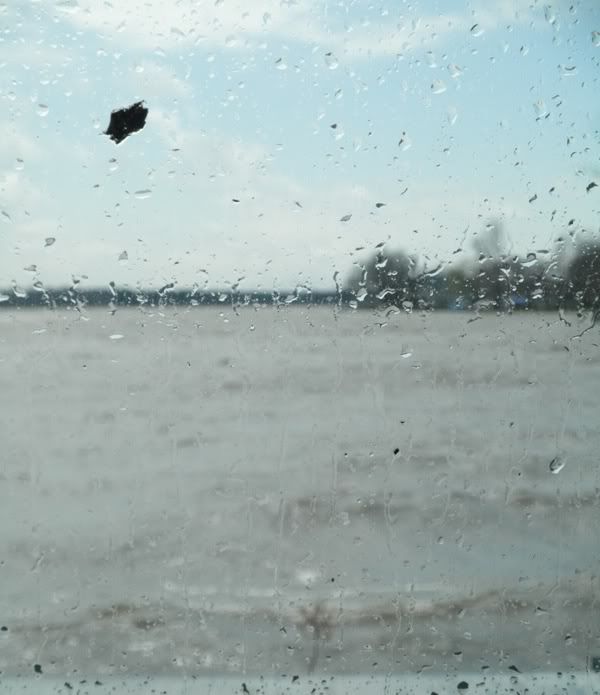
This is one of those ever so popular perspective shots. I am sitting inside my car, looking at the inside of the passenger side window. The car is at least twenty feet away from and six feet above the water. The water on the window has been carried by the wind off the tops of waves and slammed into my car.
These are various trees across the road from the pond. I wanted to give an idea of how hard the wind was blowing, but I'm not sure how successful I was. The bare tree in the middle of the background gives you the best notion. Remember, trees aren't fragile little stick things. They're serious creatures that have withstood a lot of bad weather over time to become as tall as they are.
So, that's the pond - and the other ponds along that road were mirror images of Cranberry that day. I just had better parking on Cranberry so I decided to use it as an example.
Then, two weeks later, after more rain and more wind and then more rain, I woke hearing the same odd sound that I'd heard before I went to sleep the night before. No, it wasn't my evil twin Skippette asking for breakfast. I promise. She's not a big breakfast eater, anyway.
I couldn't figure the sound out. So, in typical "me" fashio, I got myself into my Monte C. and headed in the direction of the sound. Correction. Of the roaring sound.
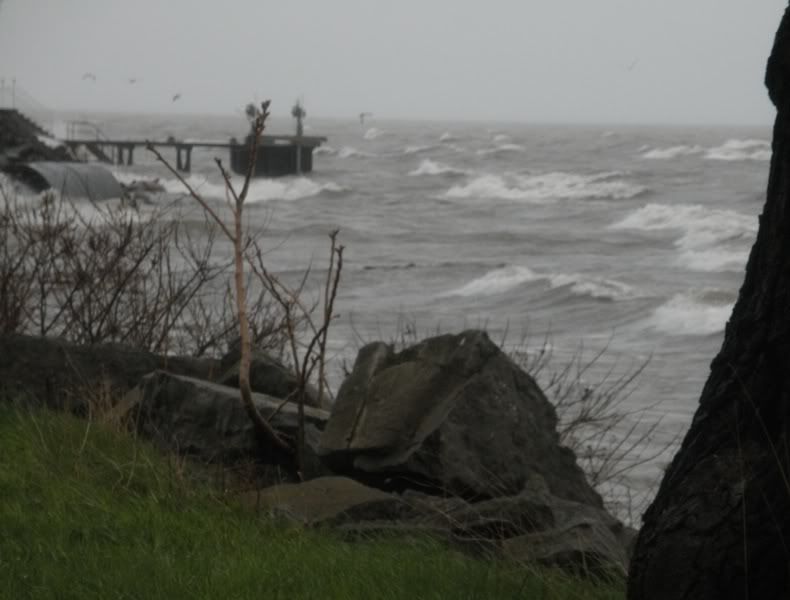
The wind was a nor'easter, and the roar was the sound of Lake Ontario's waves crashing against the shore. I live about 3/4 of a mile as the sparrow flits from the shore of the lake: it's a bit longer by road.
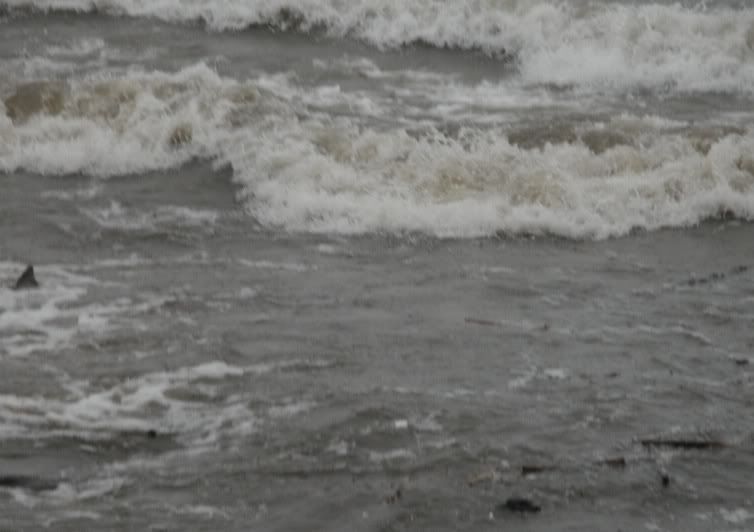
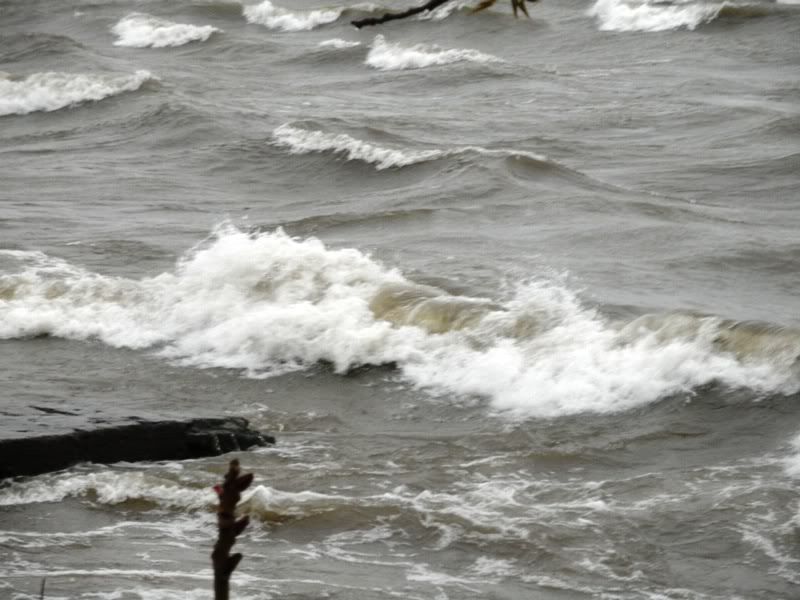
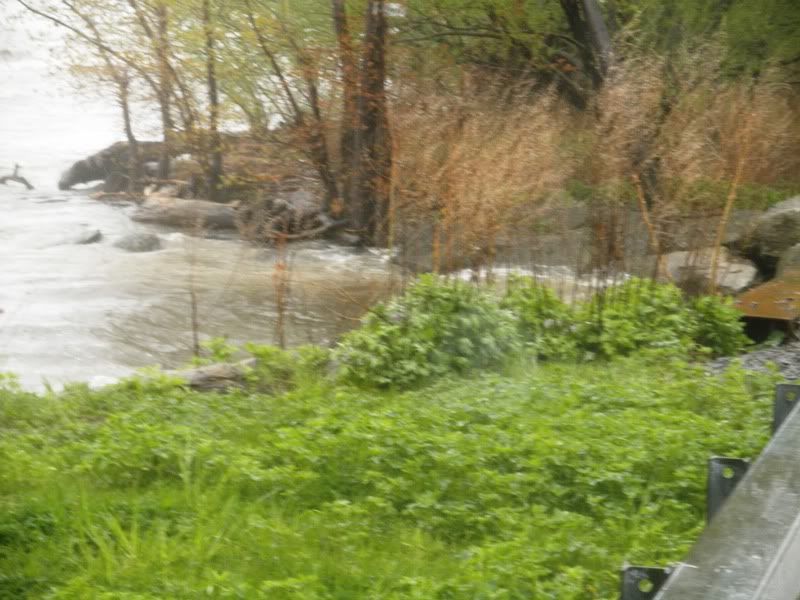
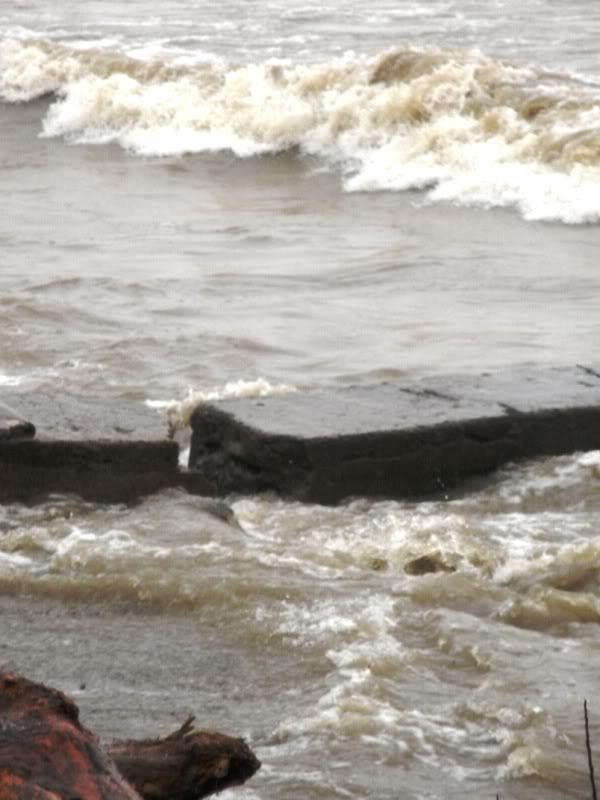
See the rock in the lower left? Again with the perspective giving. Oh - I didn't make the pictures greytone or anything. This is what the color of the world was like that day.
This is the rock as the waves withdraw.
But in the nearest cove, the water is quieter, although there is a steady stream of it pouring from right to left as a creek empties into the Lake.
This is, by far, not the worst I've ever seen, but the roar of the waves came so clearly and the wind blew so strongly that I knew I wanted pictures to put out in a blog, if ever I decided to do such a thing.
The Genesee River starts way down to the south of Rochester in the Southern Tier, more or less. It empties into Lake Ontario via Charlotte. And it runs straight through Rochester on its way. After days of rain and then a little more rain followed by a LOT more rain all around and over us, I knew that the Genesee would be raging on its way through town. So, camera in hand (wriststrap securely in place), I headed downtown.
I parked in the Court Street Ramp Garage, which has slots for library patrons, which I also intended to be, since I was right next to the main branch of the Monroe County Library System: Rundell Library. (Note to people moving to new places. Get a library card before anything else. At least, that's my philosophy!!!)
Now, oh goody, you get to look at a plaque:
Basically, the site where the Court Street Ramp Garage now sits was the place where, in 1886, George Eastman produced the first photographic film. The transparant film with its layers of coatings would revolutionize the art of picture taking, make moving pictures possible, and altered Rochester forever. Eastman Kodak (George Eastman made up the name Kodak. He wanted a name that would stick easily in peoples' minds. It worked) began in that small factory back then.
But I wasn't downtown to review Kodak, for which I worked for a quarter of a century (makes me sound ancient!!! Well, of course, I AM!!!). There are books out there to do that.
I was downtown to look at this:
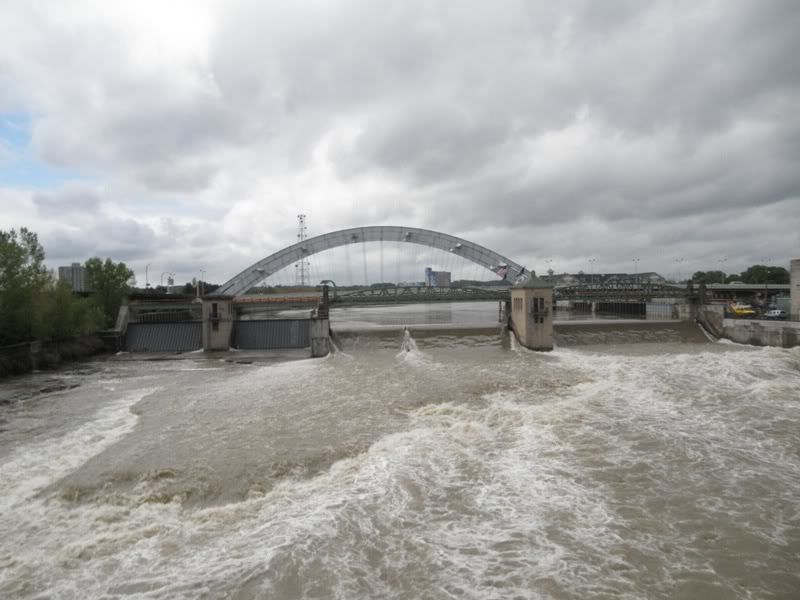
I'm standing on the Broad Street Bridge (terrified, I might add. The feeling of water roaring past you only a few yards beneath you is unsettliing.) looking roughly East at the Troup Howell Bridge. Watching the river be the river...
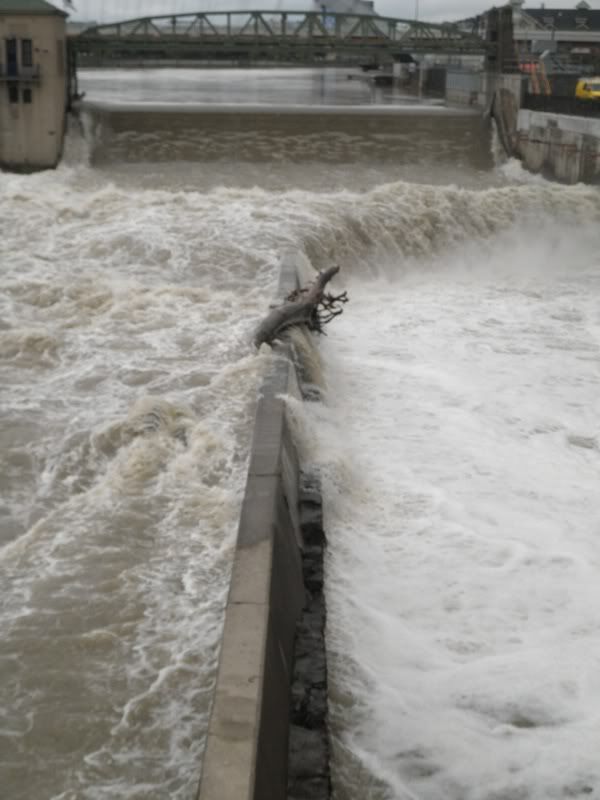
This is a shot to the left of the spillway in the previous picture. In the rough center of the picture is an area that seems to be smoother. It's a higher section of the river bed. The water is racing through on its way to Charlotte and it only looks quieter because of the smoothness of the bed.
That would be a tree trunk caught on the cement of the spillway wall. Water moves a LOT of things as if they are weightless, you know?
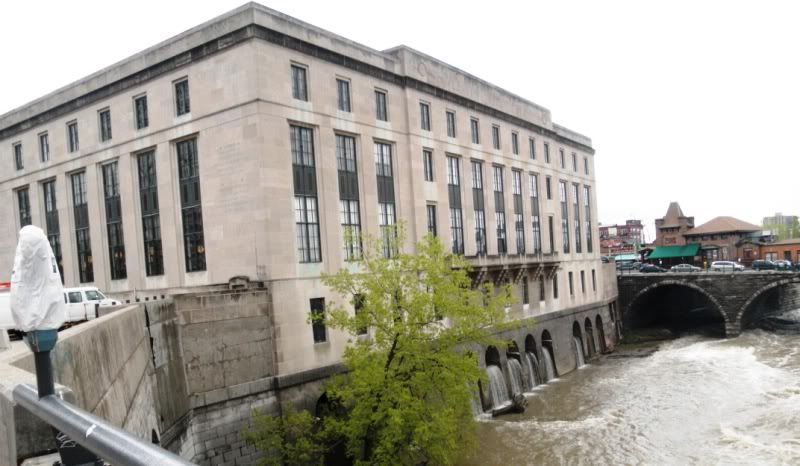
I'm still standing on the Court Street Bridge, but have walked over to the other side and am shooting in the direction of the Broad Street Bridge. The large building at the right is the main branch of the library. Overflow from the river is draining down the bank.
The Broad Street Bridge has been named to the National Register of Historic Places, as has the Court Street Bridge. It was built from 1836-1842 and was originally an aqueduct that carried boats on the Erie Canal through the city. There were 3 other major aqueducts built in the 19th century to support the Erie Canal. Ours is 800 feet long from abutment to abutment.
In the 20th century, the aqueducts was paved to serve auto traffic. The lower level (those arches you see) were part of the short-lived Rochester subway.
I walked over to the Broad Street Bridge to look back at Court Street (they run parallel to each other).
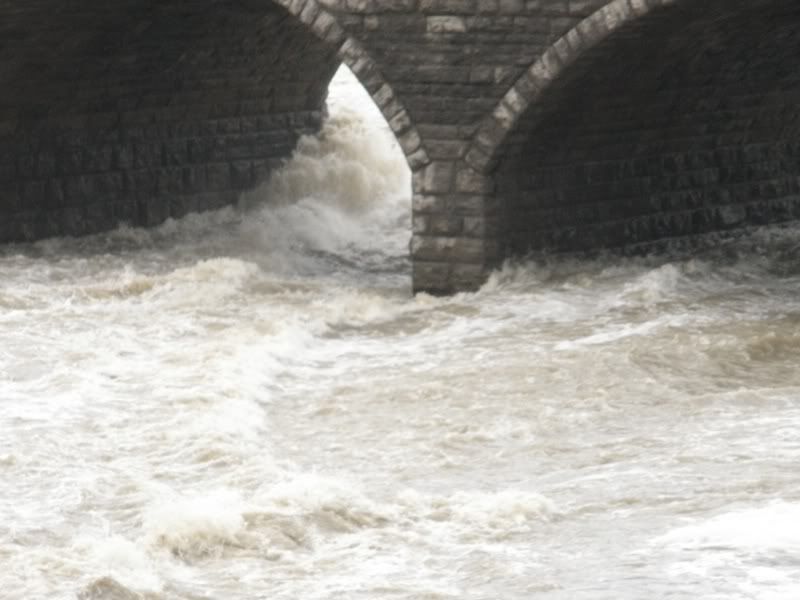
Here's the water tearing under one the arches that supports Court Street's bridge. I'm looking from a slightly greater height than I was on Court Street.
This gives a better idea of the difference in height. And shows again the power of this water as it crashes through Rochester.
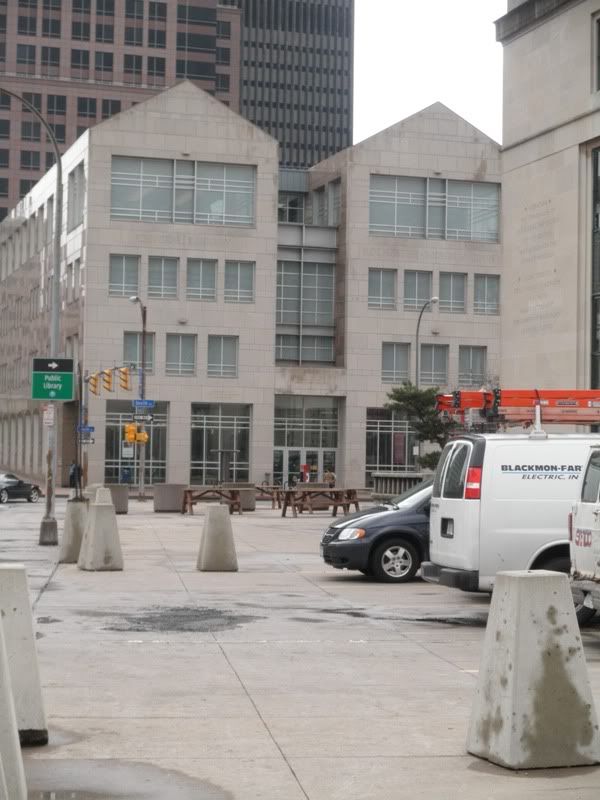
I grabbed a shot of Rundell so you'd have an idea of its size. The white thing at the lower left is a covered parking meter. Rochester has introduced kiosks where people buy time in parking spots. Note the charming blue sky? Er...grey. Yup, that would be our sky. Sigh...fortunately, things change fairly quickly (well, every ten days or so) around here.
A decade or so ago, across from Rundel, this annex (3 stories plus a lower level and underground walkway to the main branch) was built, in large part to make it possible for the public to have ready access to more of the library's vast collection. Rundel is huge, but the vast percentage of its collection was stored in the "stacks" which were open only to libary employees. If a patron needed books from the stacks, they were fetched and brought to the main desk. Now the patrons can find books they need on their own. And there's room to expand! I love the older building - walking into it is like being there when I was younger. But the new building has helped our "we love books" population (and, oh MAN do we love books!) have even more of them right there under our fingertips. MOST excellent!
Today I'm visting right here at home.
One of the things that people love to talk about (complain about, nag about, you name it) is the weather. Everyone has it, of course. And this spring, it's been a nightmare to many places in the United States.
Rochester had the wettest April on record this year, and May hasn't been a great deal more fun. But we're tough, we are and we keep going. And thanking our lucky stars that all we have to deal with is ice storms, blizzards, cold snaps and the occasional humid thundery summer. Yes, we get tornado action, but nothing like the Midwest.
With that said, I thought it might be fun (I have a VERY strange sense of humor) to take a look at wetness around Rochester.
The Genesee River runs right through Rochester on its way to Lake Ontario. Lake Ontario is the smallest (I kid you not) of the five Great Lakes (Quiz: Name 'em! Can't? Remember the acronym: HOMES: Huron, Ontario, Michigan, Erie, and Superior. The biggest? Superior: it's 350 miles long. The shallowest? Erie: which is a woeful thing when the winter winds begin to blow across it.)
Lake Ontario is only 193 miles long and 53 miles wide at its widest point. Lake Erie is 210 miles by 57 miles. Lake Michigan is 307 miles long and 118 miles at its widest. Lake Huron is 206 miles long by 152 miles wide, but has the longest shore length (Quiz: Why?) Lake Superior is 350 miles long by 160 miles wide.
This spring, the effects of the winds and rains have been moderately spectacular. Lets start with Cranberry Pond on a very windy day.
This is a very sketchy map of Lake Ontario near where I live in Greece. As you can see, there is a series of small ponds across from the larger mass of Lake Ontario. Actually, homes exist on the narrow white band right at the edge of the lake. I'm telling you that just to give you an idea of the lay of the land.
Find Cranberry Pond. This is what Cranberry Pond looks like on a day when the winds are blowing from the Southwest toward the Lake. Ontario, by the way,is calm as it can be at the same time Cranberry Lake looks like this:
Those would be white caps. I actually stayed in the car to take most of my pictures because I felt like I was blowing over when I ventured outside!
This is a ringbilled seagull attempting to land on the pond during a windstorm. Eventually, he decided to fly with the wind and land across the street (which is behind me, as I had pulled off the road) where things were somewhat quieter.
This is one of those ever so popular perspective shots. I am sitting inside my car, looking at the inside of the passenger side window. The car is at least twenty feet away from and six feet above the water. The water on the window has been carried by the wind off the tops of waves and slammed into my car.
These are various trees across the road from the pond. I wanted to give an idea of how hard the wind was blowing, but I'm not sure how successful I was. The bare tree in the middle of the background gives you the best notion. Remember, trees aren't fragile little stick things. They're serious creatures that have withstood a lot of bad weather over time to become as tall as they are.
So, that's the pond - and the other ponds along that road were mirror images of Cranberry that day. I just had better parking on Cranberry so I decided to use it as an example.
Then, two weeks later, after more rain and more wind and then more rain, I woke hearing the same odd sound that I'd heard before I went to sleep the night before. No, it wasn't my evil twin Skippette asking for breakfast. I promise. She's not a big breakfast eater, anyway.
I couldn't figure the sound out. So, in typical "me" fashio, I got myself into my Monte C. and headed in the direction of the sound. Correction. Of the roaring sound.
The wind was a nor'easter, and the roar was the sound of Lake Ontario's waves crashing against the shore. I live about 3/4 of a mile as the sparrow flits from the shore of the lake: it's a bit longer by road.
See the rock in the lower left? Again with the perspective giving. Oh - I didn't make the pictures greytone or anything. This is what the color of the world was like that day.
This is the rock as the waves withdraw.
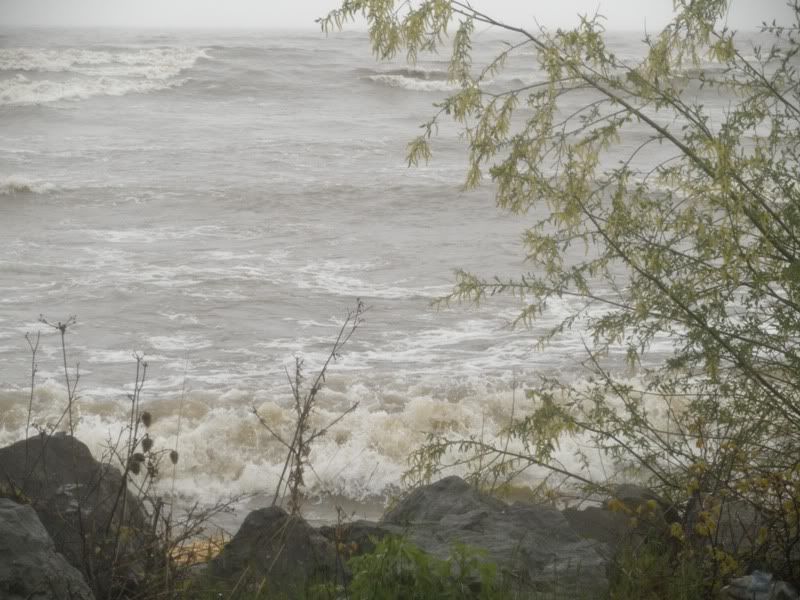
Here's a shot with a little green in it to relieve the greyish brown (taupe?). If you look out toward the horizon, you can see a line of swells that gives you (you guessed it. Sorry!) another perspective of how heavy the wave action was.
This is, by far, not the worst I've ever seen, but the roar of the waves came so clearly and the wind blew so strongly that I knew I wanted pictures to put out in a blog, if ever I decided to do such a thing.
The Genesee River starts way down to the south of Rochester in the Southern Tier, more or less. It empties into Lake Ontario via Charlotte. And it runs straight through Rochester on its way. After days of rain and then a little more rain followed by a LOT more rain all around and over us, I knew that the Genesee would be raging on its way through town. So, camera in hand (wriststrap securely in place), I headed downtown.
I parked in the Court Street Ramp Garage, which has slots for library patrons, which I also intended to be, since I was right next to the main branch of the Monroe County Library System: Rundell Library. (Note to people moving to new places. Get a library card before anything else. At least, that's my philosophy!!!)
Now, oh goody, you get to look at a plaque:
Basically, the site where the Court Street Ramp Garage now sits was the place where, in 1886, George Eastman produced the first photographic film. The transparant film with its layers of coatings would revolutionize the art of picture taking, make moving pictures possible, and altered Rochester forever. Eastman Kodak (George Eastman made up the name Kodak. He wanted a name that would stick easily in peoples' minds. It worked) began in that small factory back then.
But I wasn't downtown to review Kodak, for which I worked for a quarter of a century (makes me sound ancient!!! Well, of course, I AM!!!). There are books out there to do that.
I was downtown to look at this:
I'm standing on the Broad Street Bridge (terrified, I might add. The feeling of water roaring past you only a few yards beneath you is unsettliing.) looking roughly East at the Troup Howell Bridge. Watching the river be the river...
This is a shot to the left of the spillway in the previous picture. In the rough center of the picture is an area that seems to be smoother. It's a higher section of the river bed. The water is racing through on its way to Charlotte and it only looks quieter because of the smoothness of the bed.
That would be a tree trunk caught on the cement of the spillway wall. Water moves a LOT of things as if they are weightless, you know?
I'm still standing on the Court Street Bridge, but have walked over to the other side and am shooting in the direction of the Broad Street Bridge. The large building at the right is the main branch of the library. Overflow from the river is draining down the bank.
The Broad Street Bridge has been named to the National Register of Historic Places, as has the Court Street Bridge. It was built from 1836-1842 and was originally an aqueduct that carried boats on the Erie Canal through the city. There were 3 other major aqueducts built in the 19th century to support the Erie Canal. Ours is 800 feet long from abutment to abutment.
In the 20th century, the aqueducts was paved to serve auto traffic. The lower level (those arches you see) were part of the short-lived Rochester subway.
I walked over to the Broad Street Bridge to look back at Court Street (they run parallel to each other).
Here's the water tearing under one the arches that supports Court Street's bridge. I'm looking from a slightly greater height than I was on Court Street.
This gives a better idea of the difference in height. And shows again the power of this water as it crashes through Rochester.
I grabbed a shot of Rundell so you'd have an idea of its size. The white thing at the lower left is a covered parking meter. Rochester has introduced kiosks where people buy time in parking spots. Note the charming blue sky? Er...grey. Yup, that would be our sky. Sigh...fortunately, things change fairly quickly (well, every ten days or so) around here.
A decade or so ago, across from Rundel, this annex (3 stories plus a lower level and underground walkway to the main branch) was built, in large part to make it possible for the public to have ready access to more of the library's vast collection. Rundel is huge, but the vast percentage of its collection was stored in the "stacks" which were open only to libary employees. If a patron needed books from the stacks, they were fetched and brought to the main desk. Now the patrons can find books they need on their own. And there's room to expand! I love the older building - walking into it is like being there when I was younger. But the new building has helped our "we love books" population (and, oh MAN do we love books!) have even more of them right there under our fingertips. MOST excellent!
So, having taken the pictures I wanted of the water of the Genesee, and having wandered happily through the library for an hour, I decided to borrow 2 books (The Desert and the Sown by Gertrude Lowthian Bell (who was one incredible lady!), published originally in 1907 (the book I borrowed is from the 1928 third printing) and Roadside Geology of Maine which is a state with one HECK of a geologic history!)) and wended my way back home.
When I say I wander? Ya gotta believe I WANDER! Until next time!
Subscribe to:
Posts (Atom)