Friday, August 12, 2011

Old Sarum, oooops, Salisbury!

Remember the map I posted in my first blog about this trip?  And then, last blog, I did a frighteningly rapid over view of Salisbury.  NOW I'm going to slow down a bit because I was getting motion sickness and all.

Old Sarum, you mutter.  What in the dickens is old Sarum?  From Google Earth, I have borrowed a picture.  Here it is below.  Looks kinda...er...under developed?  Or resting from too much development, I suppose.

What you are looking at is a classic motte and bailey site.


Briefly:  the motte (not moat) is the flattened mound in the center of the ditch you see.  The bailey is an enclosed courtyard, usually adjacent to a fort or a castle built on the motte. 

The term motte and bailey was not used during medieval times.  (It would be sort of like me calling the house I grew up in mid-century modern while I was growing up in it.  "Yes, I'm going to clean that bathrooms in my mid-century modern home."  Not happening so much.

Instead, I'm guessing that people back then said that they were going to market up in Sarum.  "Going to sell my chickens in t'market today."  The castle that was built by the Normans was used by Henry II Plantagenet and the Plantagenet kings.  (Recall the Lion in Winter or Becket, both of which starred Peter O'Toole as King Henry II, but at different times in his life.  Abstruse and totally inconsequential trivia that.)  The Plantagenets ruled England from 1154 through 1485. 

Sarum saw a number of different societies over the centuries.  And the first Salisbury cathedral was built at Sarum.  If you look at the picture, you can see the ruins of the foundation just off to the upper left away from the motte.

But archaeological explorations have revealed the presence of humans on this site since at least 3000 BCE. The Romans built a town here (mostly because they could, I'm sure...the Romans were rather fond of building things, and they did a great job of it.)

I'm not going to go on and on about the history of the area, mostly because (and this startles me every time) people are not all agog to hear every little detail.  Sooo...let's just get moved from Old Sarum to New Sarum.

New Sarum is a couple of miles from Old Sarum and the cathedral at Salisbury just happens to be built on a large anomoly - a wide bed of naturally occuring gravel provides drainage in an otherwise clay-y location.  In addition, it is the one place in what is now Salisbury where the supports needed to keep the cathedral intact could be sunk. 

Of course, there is a legend about it.  (Homework - go see if you can find the legend). 

By hook or by crook, the new cathedral located in New Sarum (soon to be called Salisbury) was begun in 1220. 

Remember, however, that building a cathedral required vast resources in terms of money, raw materials and manpower.  So, even though the cathedral was dedicated in 1258, major sections of the church itself as well as the cloisters and close and its wall were built over the next 250 years.  The fortunes of the cathedral reflected the fortunes of the times themselves, and major renovation has been done several times in the past as well as being on-going today.

So what's all the fuss about?

Hmmm

Here -


This is one facade of the cathedral - off to the left you can see the scaffolding enclosing part of the cathedral that's being cleaned and restored.  The major entrance to the cathedral is off to my right.

Because I'm the world's most idiotic thinker, I didn't get a good shot of the main entrance to the cathedral.  I therefore have borrowed a picture from a webpage called PlanetWare.

I DID however take a lot of pictures of the statuary on this entrance. Statues have been set into their niches over the centuries.  Another proof that the church is a living thing is the fact that there are empty niches waiting for someone else to occupy them.


The last picture is the outside view of a stained glass window...heh...nothing much to look at until you get inside.

Which (since it's going on midnight) we'll do tomorrow!  I leave you with some pretty flowers that were at one of the altars.


This arrangement was extremely tall and wide.  But it was also gorgeous.  Can't help it - loves the flowers!

Hasta manana, amigos!

Tuesday, August 9, 2011

Salisbury Part 1 or so

Now, everyone knows I'm completely allergic to doing things in any kind of order unless it's shoved down my throat.  Sooooo....I'm going to focus on Salisbury first.

Mostly because I can.  Heh...

First things first.  Some piccies (bet you thought I was going to do a history lesson.  Not yet - I'll sneak one in sort of sideways when you're lookin' at the piccies.)


Okey dokey!  The pictures above are a fair to middling cross section of the kind of picture I take when jet lagged.  No, not really.  Ignore me.  I'm really this wobbly in the picture making department ALL the time!!!!

The chimney pots (no, not chamber pots - I heard that!) fascinate me.  They come in all shapes and sizes and make the rooflines of places really interesting.  The other buildings are old, although I think (Chris, correct me if I'm wrong) that Nugg's 1268 is the most elderly.

And, as recently as the end of the twentieth century, no one really knew how old the building was!  It was only when a renovation was begun  and layers of exterior (and, I think, interior) plaster were peeled away that the age of the building became more obvious. 

As soon as it was clear that the renovators were dealing with something of great age, work was stopped and a license applied for to declare the building a landmark.  At the same time, those who have the rare gift of being able to research such things began their dig through the records.  They are not allergic to dust, paper fibres or the prospect of spending weeks trying to decipher clerical handwriting.  Bless 'em all!

There were other clues as to the age of the building.  For example, note that the outside timbers are more grey than dark brown or black.  That's because, early on, when beams were sealed, they were sealed with lime. 

Remember, of course, that the building was added on to, its front door moved, and any number of other changes made to it over the centuries.  That's the nature of the beast (Don't ask how many updates were made to the house I grew up in just while I was living there!).  However, the building visitors see today (besides being a functional business) dates back to the 13th century. 

I have just spent an hour updating my pictures because I thought I had lost about half of them.  I hadn't, but I hadn't followed my usual protocol with pictures and back ups, so I have to go in and make things well again.

I'm going to close this portion of today's blog with some pretty flowers.  Salisbury keeps itself all beautiful with flowers and a rather unique Dragon.


ENGLAND!!!!!!

Hullo!  I have returned from my most excellent trip to the UK!  I have met face to face folk who have suffered with my IM-ing and blogging for the last year or two, and they have not been damaged by the experience!  (I am sooo proud that I didn't cause any nervous tics or hysteria!!!). 

And I have taken pictures (surprise!).  Rather a great many pictures, but, again, we ARE talking about me, the novice digitalist here...

First off, just a brief note in regard to where exactly I went in England. 

Also, for the sake of all concerned, a map to go with the note. 

Admittedly, this is a LARGE-ish map.  But I wanted to be sure I didn't cause anyone eye strain...

This is England and Wales.  I was in England, although NEXT time....smiles cheekily.

So, find London - do you see it there?  Good.  I landed at Heathrow Airport, which is one of the two large airports serving the London area:  Gatwick is the other one. 

However, my eyes and travels turned away from London almost immediately.  My goal was to visit friends and to see their parts of England.  Visitng London is probably a lot like what I imagine visiting Washington DC is like, but with several more centuries of  historic buildings and stories and such.  I had decided I wouldn't attempt such a thing on my first foray to England.

I visited (and was completely overawed by) Salisbury, Oxford, Avebury, Newcastle-upon-Tyne, Gateshead, Durham, and York.  If you want to take a second and locate them, you'll get an idea of where I was at any particular point in time. 

To get to the places I visited, I traveled via train (I like trains a lot!!!!), bus, coach (not the same thing), airplane (from N-u-T back to Heathrow the day before I came home), a car, a cab and by foot while I was visiting.  I didn'[t do anything boat-y.  BUT there's always next time!

And we're off to the races!!!!


Friday, July 8, 2011

Genesee Country Village - Part the First (aren'tyou excited?)

Before I begin to commence (think about that and I guarantee you, you will become a headache on legs), as background.

Everyone reading is more or less familiar with the notion of "living museums".  Williamsburg Virgina is such a place, and, possibly, the best known.  But there are other places scattered throughout the country, as well.  Some are small, some are large.  They all bring the visitors' focuses (foci? focaacia? Oh dear..it's only the second paragraph) to a time not in the "now".  Sturbridge Village, the Plymouth Plantation...and Genesee Country Village and Museum (GCV)

Fortunately (for me) or unfortunately (for you!), GCV is a mere 26 minute drive from my humble hobbit hole in Greece, NY.  I have loved going there for decades (yeah, so I'm sligihtly older than 30...) and have watched it grow all that time.

The Genesee River (after which the beer is named) flows North from the Southern Tier toward Lake Ontario.  (Remember, in this case, North is a lower altitude than South).  As it wends or thunders or tiptoes its way (and we've seen pics of the river raging through downtown) it has provided water, transport, power, and some nifty geology to the people who have setted in the region.

Here are a couple of shots of the river.  The first is Middle Falls and Upper Falls in Letchworth State Park, south of Rochester.


And we all remember the pictures of the river rampaging through at Broad and Court Street Bridges in downtown Rochester.


Colonel Nathaniel Rochester acquired 100 square acres of land (someone should take a look at land acquisitions and such during the settlement period.  It's enough to make a body's head spin widdershins!), which was named Rochesterville in 1817.  In 1821, when Monroe and Wayne counties were formed, Rochesterville became the county seat.  Don't ask.  I don't think they sat down any more than anyone else, really!

In small towns and hamlets all around Rochesterville, other settlers were claiming land and starting new lives.  Some of the towns are still in existence; some are  not.  People were farmers and teachers, ministers and tavern owners, land agents and insurance reps (yup, even back then.). 

And, for the next couple of hundred years (well, I'm only going as far as the timeline for GCV goes), the area continued to change and to grow.

Buildings had to be constructed to be TOUGH, and I don't mean maybe.  Exterior painting of homes wasn't common until into the 19th century, so the wood from which homes were built was exposed to our charming humidity and heat in the summer, rain and sleet and snow all the other three months, and the occasional storm or flood.  Not surprisingly, a number of buildings from centuries past survived or at least managed to hold themselves upright well into the 20th century.

Which is where our story begins.

I could go on forever, but I'm not going to.  Jack Whele, a philanthropist and appreciator of the history of the Genesee Valley, purchased 600 acres of land in Mumford, NY in 1966.  He had a vision:  he wanted to find and move to the village buildings representative of the settlement years of Western New York, focusin on the 19th century, but with some earlier buildings if possible.

Mr. W's feeling was that, just as fine arts represent the culture of a society, so do the crafts (carpentry, husbandry, tin smithing, etc.).  He wanted to preserve the history of such things and wanted the public to be able to experience them in an outdoor setting.

That was the beginning.

And this is what it's like today.


I know it's a small map, but  - the front gate is near the bottom of the map.  The Great Meadow (shades of Bilbo's Birthday Party!) separates the more modern buildings from the village itself.  And the old Toll Road Gatehouse is the place to step back into a different era.

Some piccies to give you an idea:


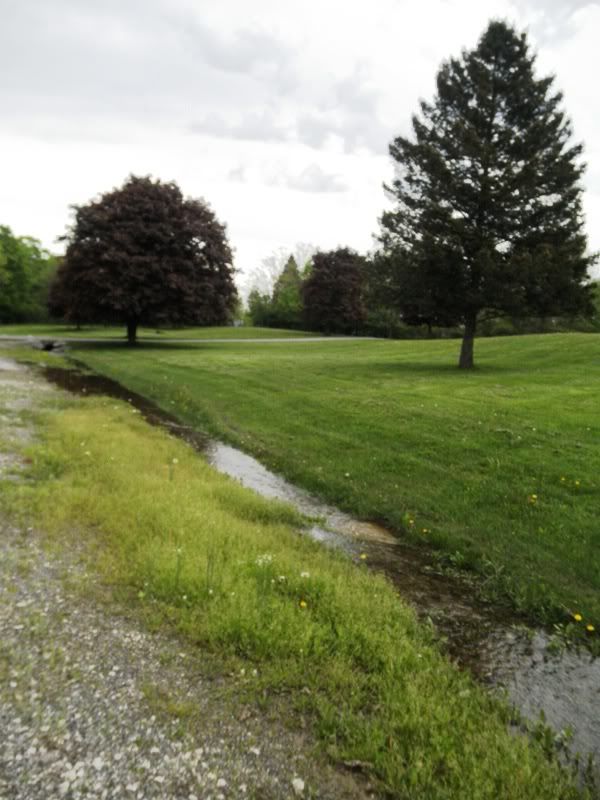
My first visit out was in late May this year, on a grey and cold day.  But I still took pictures.  The parking lot is behind me.  The tiny stream that you see in the picture is actually the result of run off:  everywhere was hugely damp this spring!


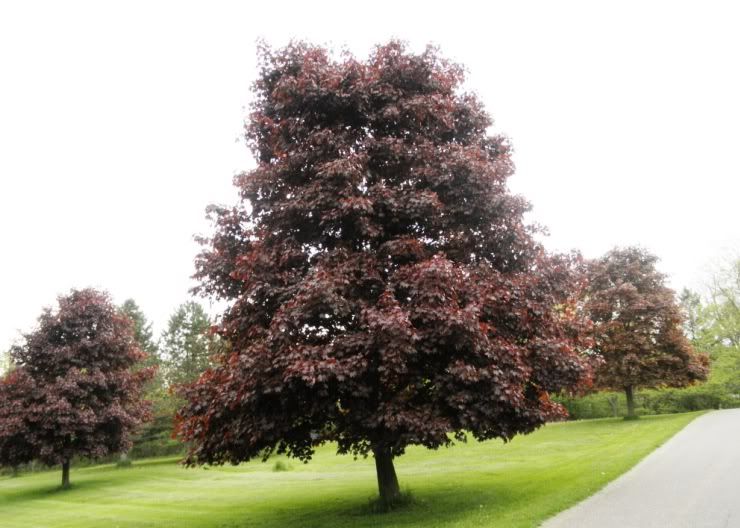
A Red Maple (or is that Oak?  Nope, Maple) at the side of the walk up to the entry.  I am a tree person so there are lots of 'em...

I just looked to see if I'd down shots of the Great Meadow and, other than the one for the Ladies' Baseball Team, I don't have any!  Bah!  Shame on me!  You can see from the map above that there is quite an expanse of space.  One can walk around the circumfrance or cut straight across the middle (much preferable).  I shall find pictures of the Bandstand the Carriage Museum and The Wehle Art Gallery and post them later.

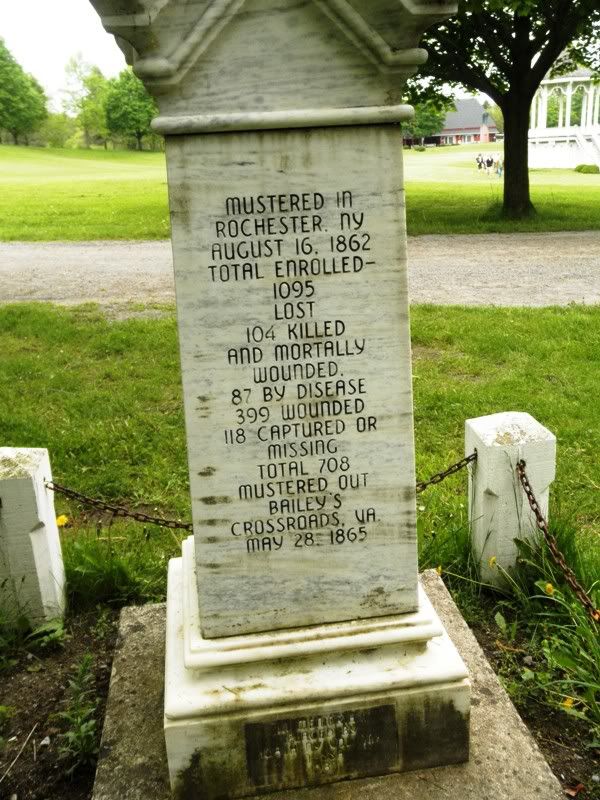
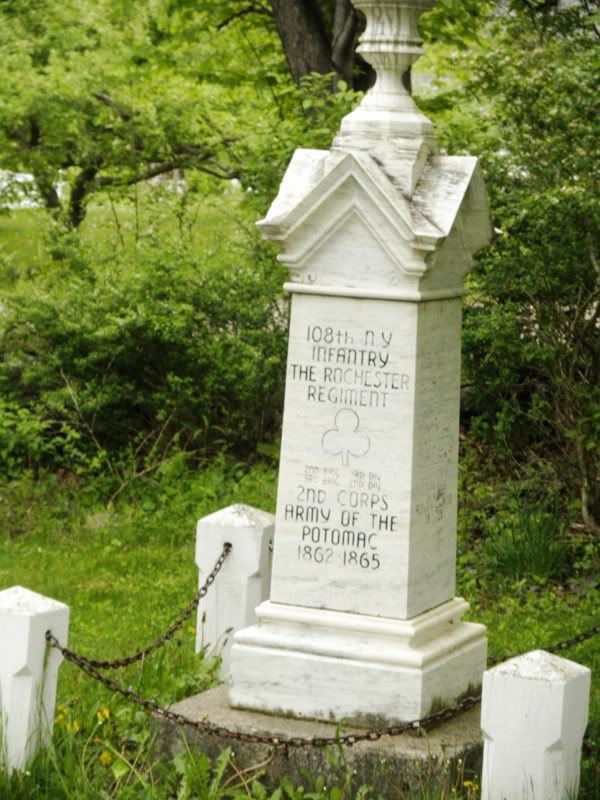
For now:  We have reached the Old Toll House.  But first, off to the right of the Toll House stands a little monument, set up with care a decade ago and in honor of one of the New York Units that fought in the American Civil War.

I was there that day.  It happened quietly and without a lot of speeches or noise.  There is inscription on all four sides (and you can see the Great Meadow in the background).  This one has the grimmest and most telling message.  Mustered in:  1095.  Mustered out: 387.


And this is the front. 


Still, the statistics and the details are only important as signposts of what effect they might have had on the population living in the Genesee Valley...

People are still respectful and quiet as they walk by this little monument.  But they are also excited about entering the village and head straight for the old toll house.


Different day - more SUN! 

That's the toll house.


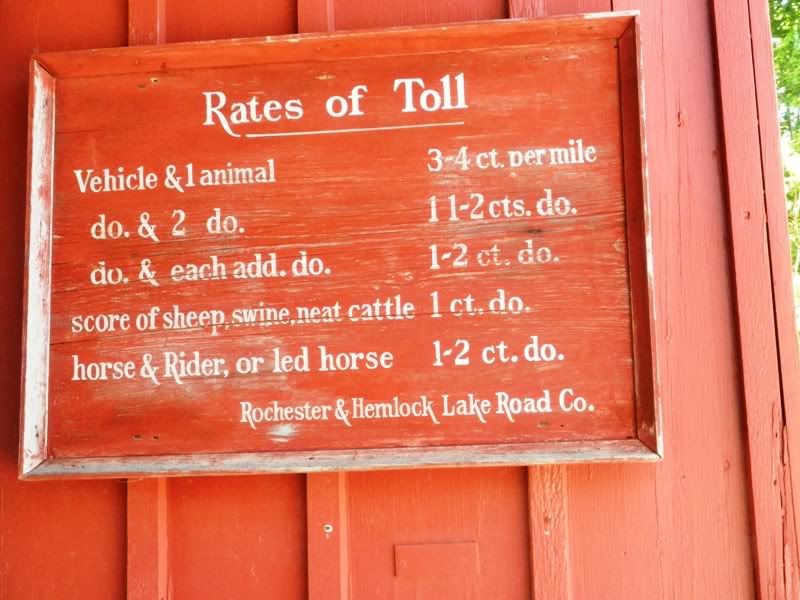
These are the tolls on the Rochester and Hemlock Lake Road Co.  Do you see the "do."?  That's the 19th century method of writing "ditto" (which we do using a quotation mark).  Ct. is, of course, cents.  I'm not sure what a cent looked like in the 19th century (I should go look), but they were definitely not the same as the ones today.

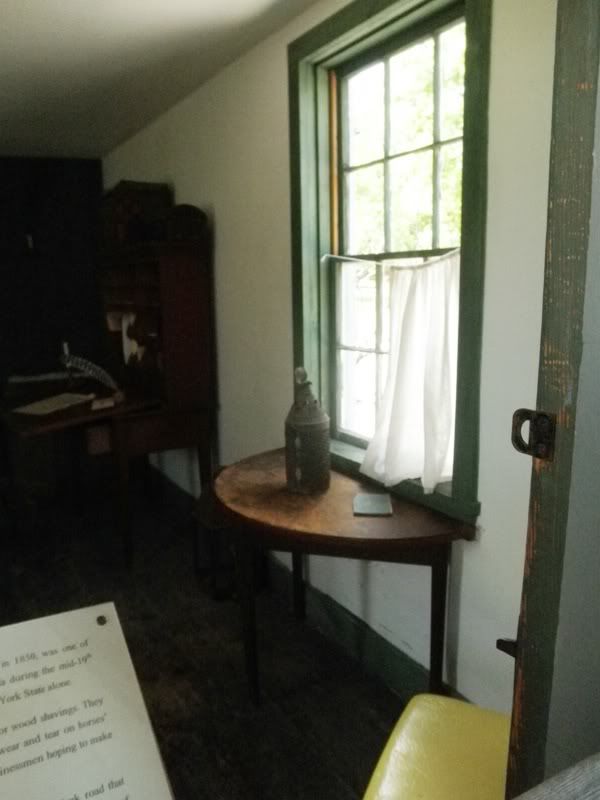
The toll keeper lived in the toll house.  And it looked like this:


There is a small sleeping room in the back (you can see the door), and the rest of the dwelling consisted of this front area.


This is just to the right of the last picture.  In fact, in the lower left is the rest of  the explanatory placard describing the building.  The curtain rod is a piece of rope (pretty handy), and the chair is upholstered in yellow fabric.  Everything here dates back to the period, including the little table under the window.

Once inside the village proper, the question is Which Way to Go????  If you were a traveller in the 19th century, you might want to go to the general store.  So that's what we're going to do.

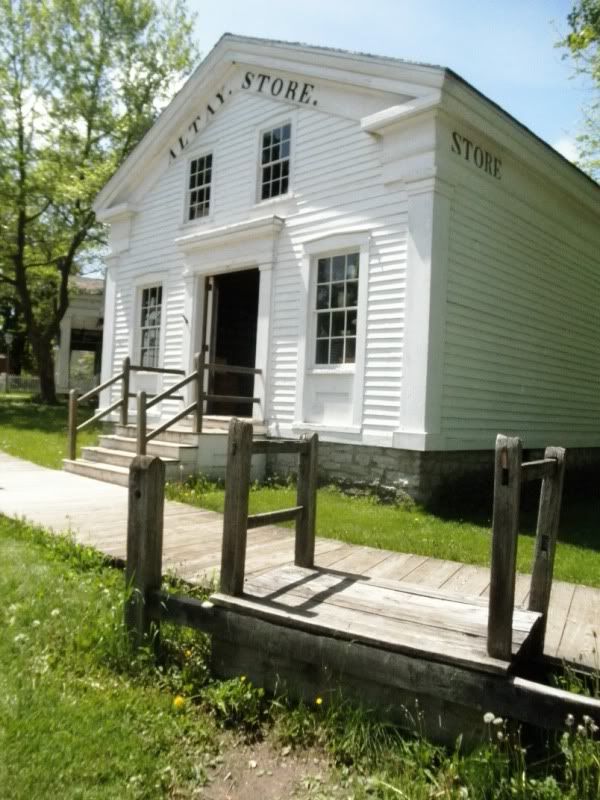
The Altay General Store was moved from Altay New York  a distance of 84 miles Northwest to Mumford.  In this case, it was moved by truck.  The family that owned the store had built their home as an extension of the store, but that was not included in the move...

If you want to locate Altay, draw a triangle among Bath, NY, Penn Yann, Ny and Watkins Glen, NY.  Smackin the just below lower center is where the tiny town of Altay is.

Here's the exterior of the store:


This is the store itself, not a reproduction.  As you can see, the sidewalks in front are made of boards.  Just wanted to toss that in!


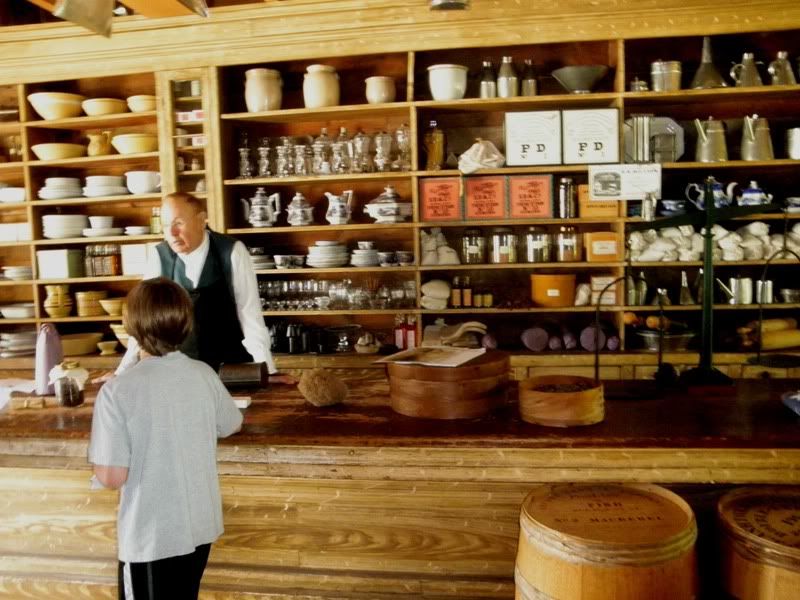
On the day (the sunny one) that I took these pictures, there were children on field trips from nearby schools and the gentleman talking to them kept 'em hopping!  His clothing is period dress, made to patterns from the time and in materials common at the time.  Everything that you see on the shelves would have been for sale in the Altay Store.  Some of the glassware is actually from the early 1800s, although some is reproduction.  There is a gorgeous set of brown toile transferware that someone donated to the museum.  And there are all sorts of boxes and cans of things. 


This is the back of the store, just to the gentleman's left (my right).  The cabinet and cases hold everything from gloves (in the glass fronted cabinet in the center, to notions (sewing equipment, guys - you know, needles and thread and that sort of thing) to lamps and up over the range of this picture, chairs hanging from the ceiling beams.  To the right is a second long counter (from the store originally as is the one the gentleman is leaning on) and behind that are bolts and bolts of yard goods, baskets, things of that nature.

Oh, and the big rectangular heap in the front is rope.  A LOT of rope.

when I first started going to the museum, there were very few things in the store, but, as the years have gone by, more and more types of merchandise have found their way in.  This store is actually really full!  They need a yard sale!  I get to buy first!!!!

And, still relaxing in the pleasant gloom of the  General Store, I bid you adiew for now.  Next time?  Hmmmmmmmm....perhaps the Hosmer Inn and a whole new definition of "underground living"????

Thursday, June 23, 2011

A Little Wander to a Little Corner

Hulloo!  This is a blog about a little wander to a little corner of a field that's grown up over the past few years in a spot that I've driven by hundreds of times, I'm sure. 

Something like six years ago, a parking lot sized space was cleared next to the Latta/Long Pond Wegmans.  Whatever was supposed to happen to it, didn't and, as often happens, the plain dirt was slowly decorated by what people call a  "field".  It's actually on the West Side of the Frontage Road that connects Wegmans to the  Mc Donalds, a day-care center, and the Latta Road brach of Eastman Credit Union (otherwise known as a bank).  I'm using the term frontage road because, in the rest of the country, that's what it would be called).

One day a couple of weeks ago, I had several errands to run and decided I'd park my car in a central location and walk to my destinations.  As has now become habit, I carried my camera.

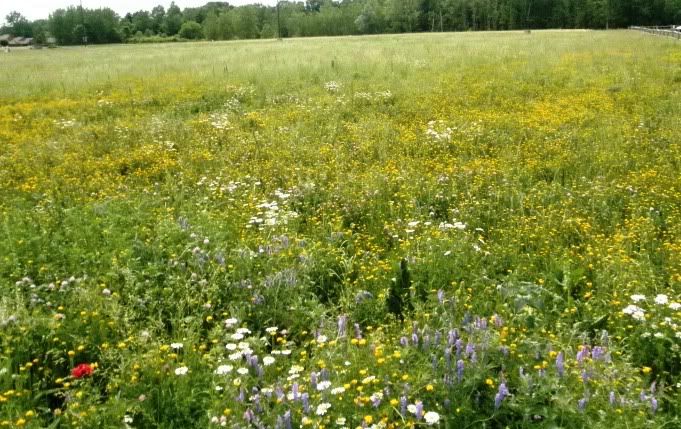
I've driven by this field SOO often and never actually seen it...I want you to see it, as well, just for grins! And because it's kinda neat


Okay - I just made this bigger.  If you'll look carefully in the upper right corner, about 1/4 down from the top?  You'll see a little white dot.  That is the hood of a car in the parking lot of the store.  So we're literally only a few yards from the day-to-day world.  And no, that's not a discarded bright red plastic cup down in the lower left.  Honest!
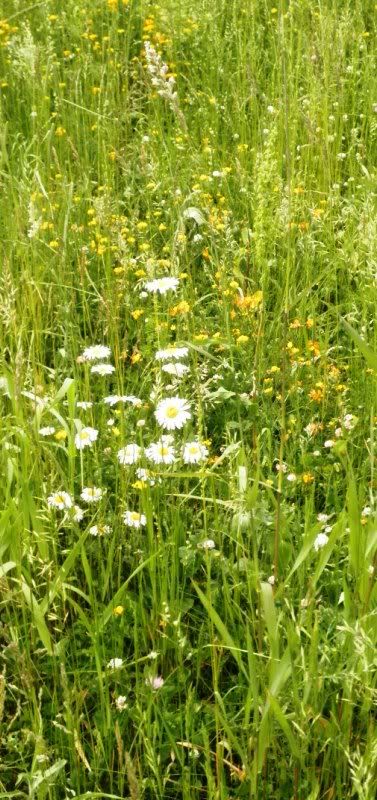
Right off the bat (where the heck did that saying come from?), I must apologize for not having the foggiest CLUE what the names of the wildflowers are.  Some look like they escaped from a backyard and have decided to go camping in this field.  But I have no skill at naming them.  Except, of course, to say they're pretty.  (I am exceptionally proud of my immense scientific background.  Can you tell?)


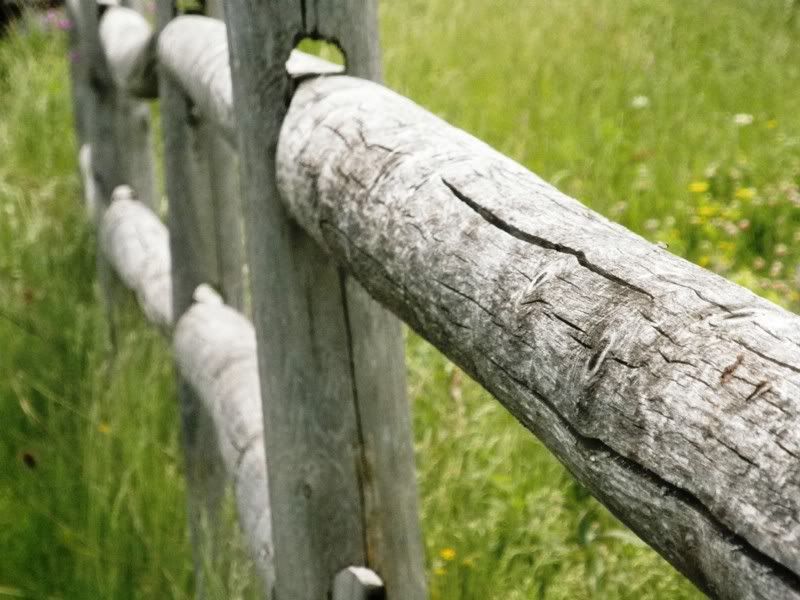
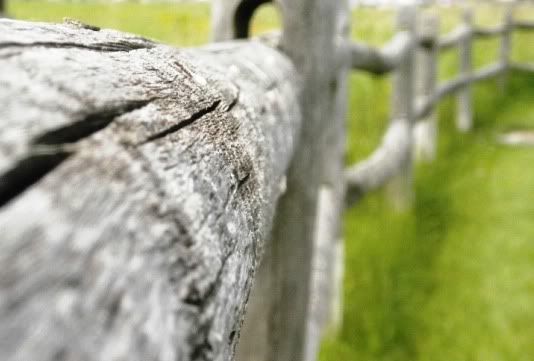
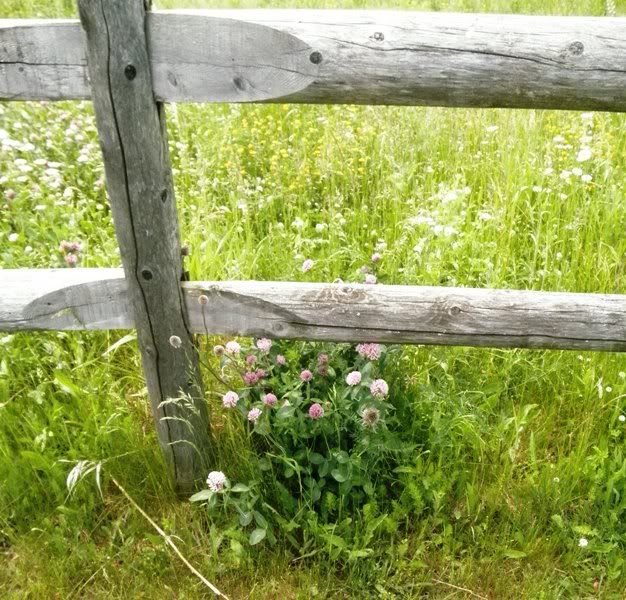
This is the fence that Wegman's put up around the field back when it was supposed to be something else. I like it, so was obliged to take several shots of it, both nekkid and with flowers.


The view a tightrope walking squirrel would have.  And me playing with wood grain and all.


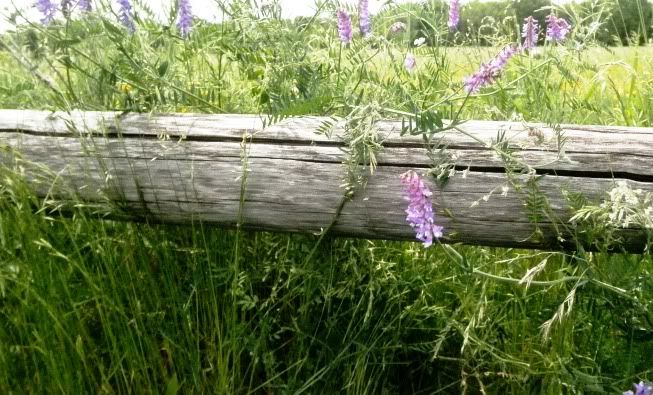
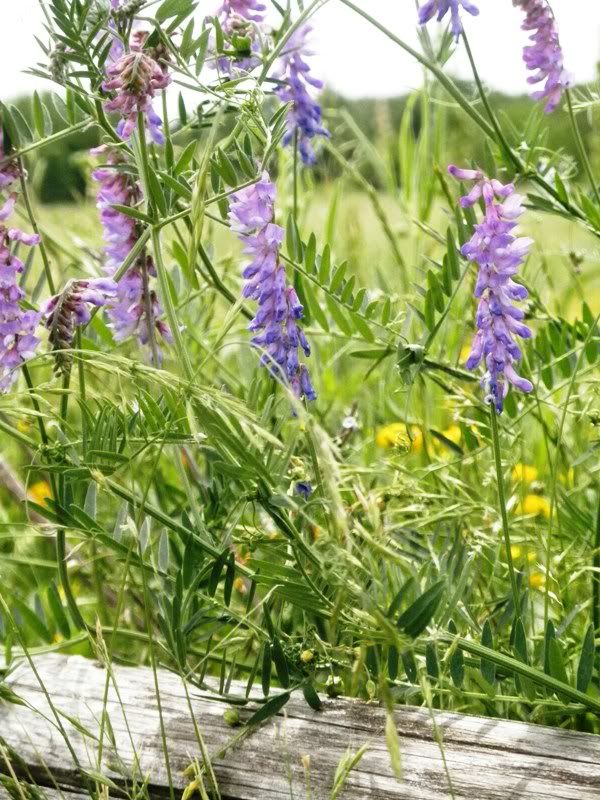
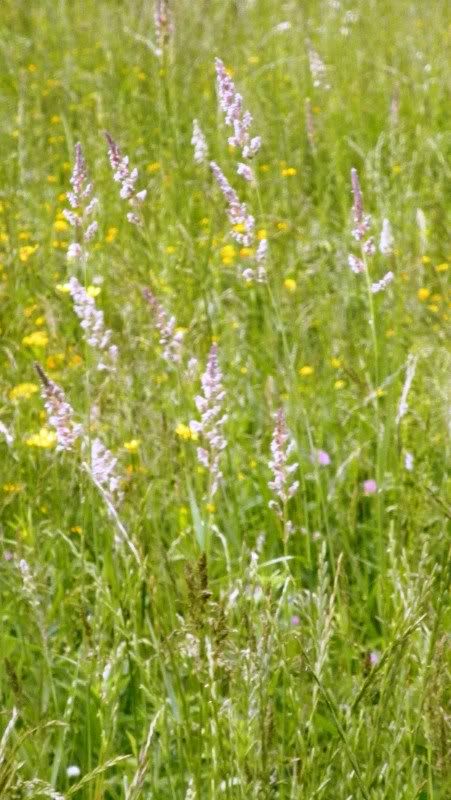
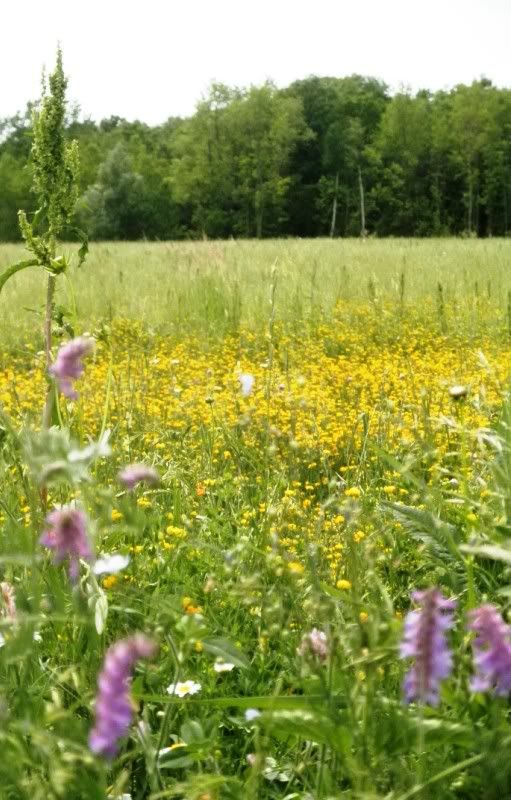
I cropped out my sneaker, which insisted on toeing itself into the bottom of the picture.  I took this sitting on the ground.  The colors of the little purple flowers were almost irridescent and varied from pinkish purple right on through to purplish blue.  Wonderful!!!!


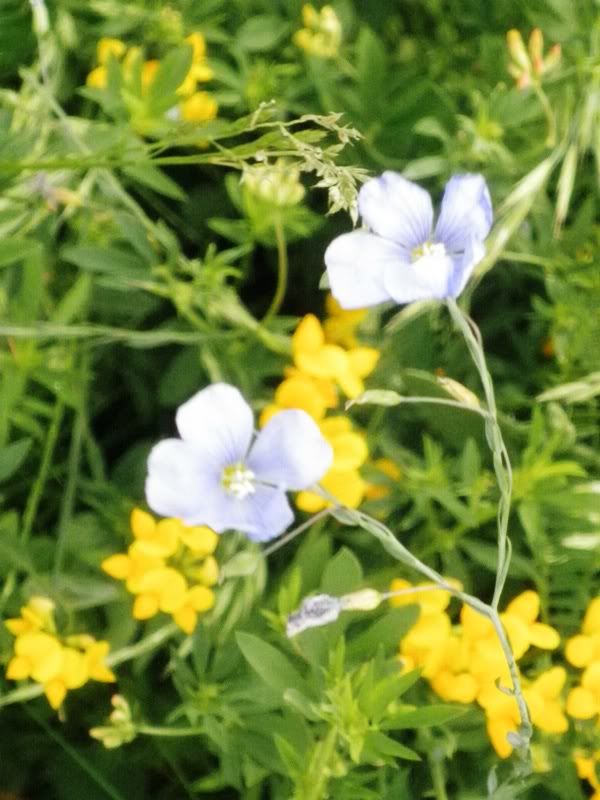
Again from the ground and again the pretty purple flowers.  They look a little like mini-foxgloves!  The yellow flowers?  Dunno, but they were tremendously cheerful to look at ! 

So, on we go to flowers and greens!


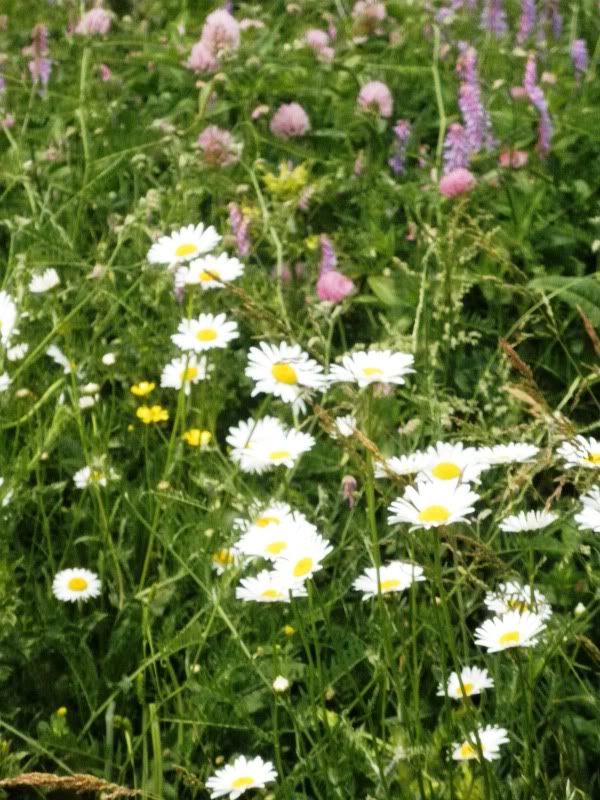
For the most part, these are daisies, I think.  The purple flowers in the backgound aren't the same as the ones by the fence, but they're pretty anyway!


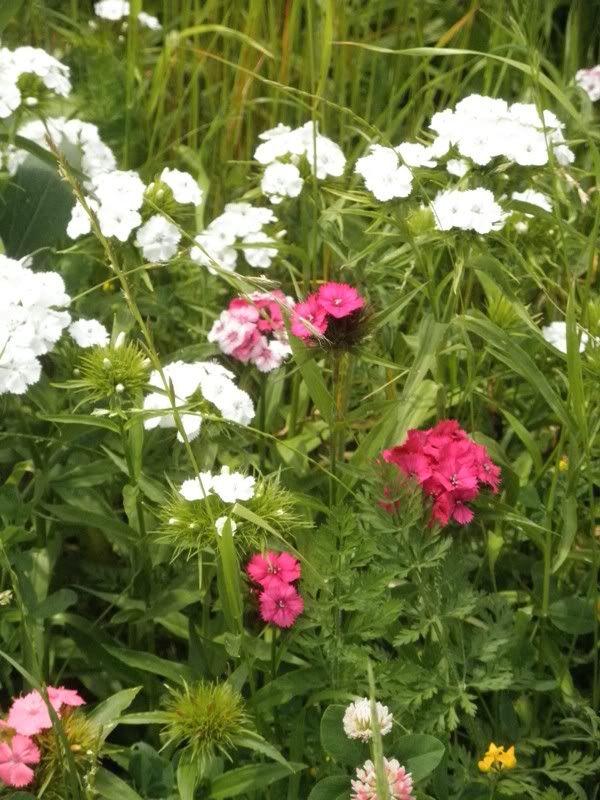
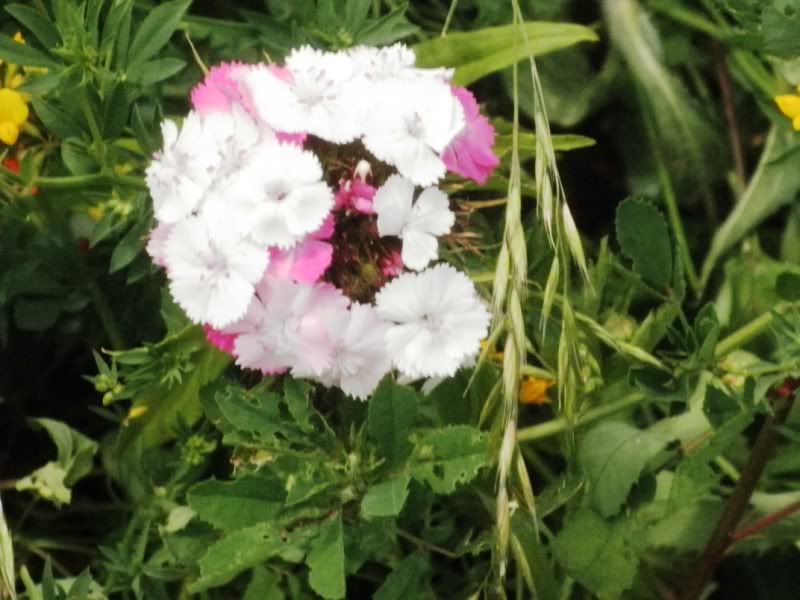
These are pretty (I know - I have to work on my vocabulary).  But what interested me the most about them is the way that the colors range from white through to deep pinkish red.  The flower in the middle has flowerets that are all diffferent shades of pink, red, and white.


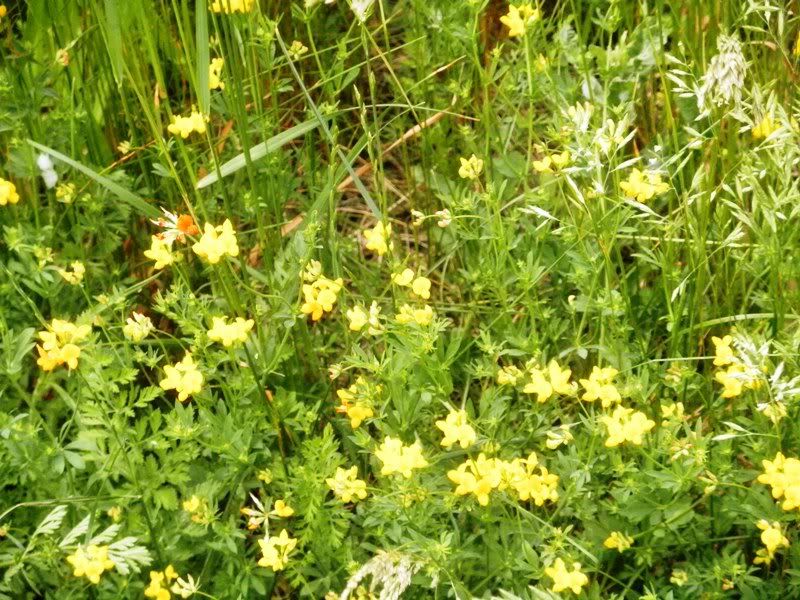
These little yellow guys look like stars!


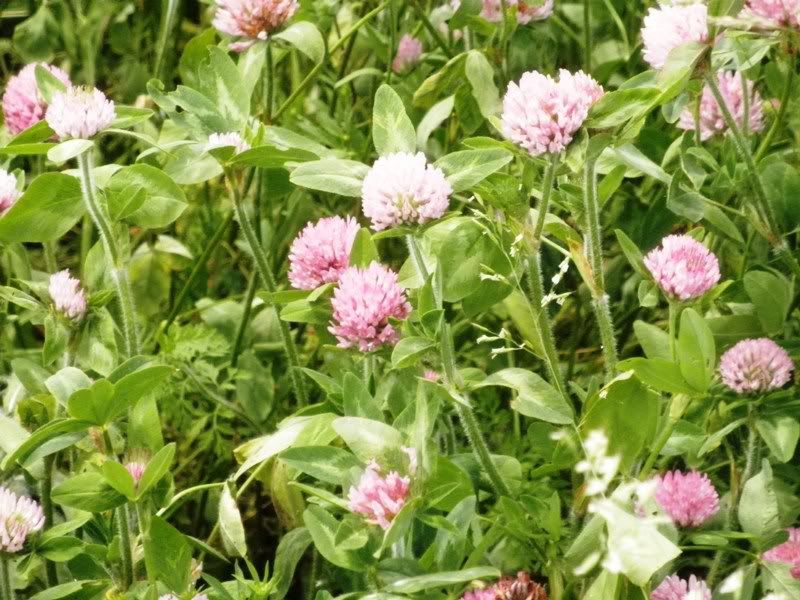
The clover shades from light pink to deeper and then to almost white (color 818 for the counted cross stitchers among us).


And the paler pastels and their stems and leaves add a quiet background of color.


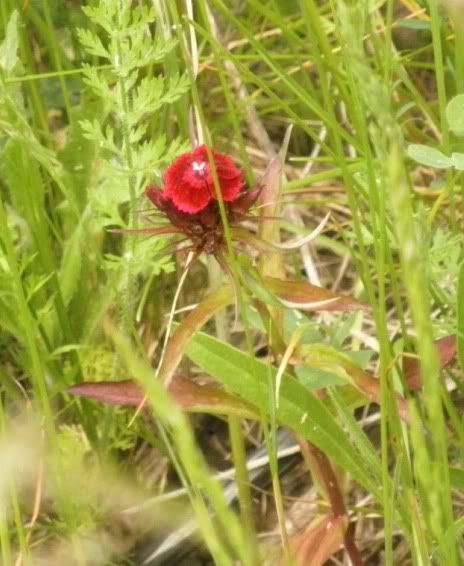
Remember that bright red splotch in the first picture?  This is the splotch up closer and more personal.  Again, I don't know what it is, but it was BRIGHT!!!!


Each of the little flowerets' petals had ruffled petals. I liked the grass as well.  There were so many different green things it was a little overwhelming!


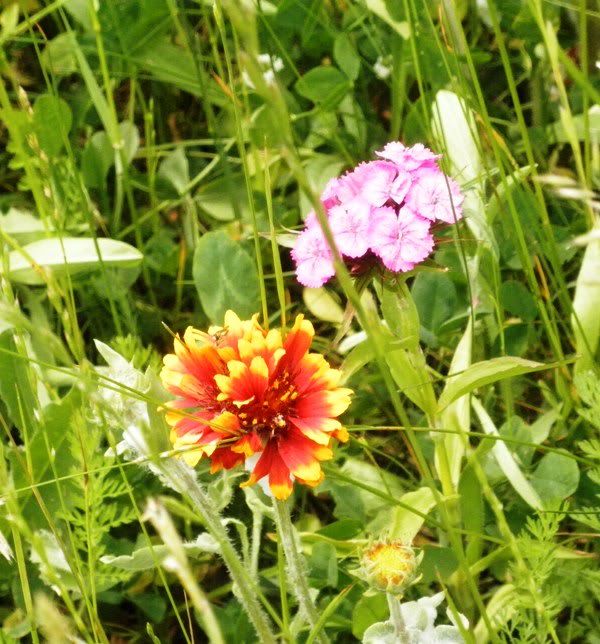
Another bright splotch of color was this flower.  I remembered seeing something like it on a web page and went looking.  It's a coreopsis.  And it seemed to be the only Coreopsis nearby.  Perhaps it had pioneered from someone's garden and decided to set up housekeepingg here!


This is just a little wander, a glimpse of a field perhaps an acre in size, on a semi-cloudy day in June in 2011.  I'm glad I decided to take that walk from the post office to the bank, or I would have missed seeing this!  Keep an eye out, because there's neat stuff all over the place!

Until next time!

Sunday, June 19, 2011

Take Me Out to the Ballgame - 19th Century Style!

Hi, folks!  This post is for Lisa and Ron because I took piccies of the baseball field out at Genesee Country Museum yesterday (the season starts today with a double header).  Now, remember, this is a league that plays ball back when the game was called  base ball (with the space between the two words) and the players wore woolen uniforms and those weird flat topped caps.  The field is set up according to the rules that were up and running in the 19th century (the first real rule book came out about 1868).

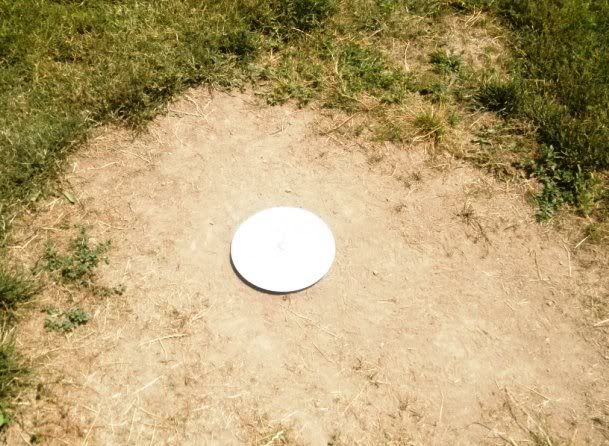
I noticed that the distance between the pitcher's mound and the plate was much shorter than it is today.  And things were a bit more "out in the open".  BUT, that being said, it appears that base ball is base ball no matter when.

According to the information on the website and also on a sign at the field, this is the first vintage base ball field (and, of course, the best, but I'm wildly biased) in the nation.  There are four local teams who play vistors from other areas in the country.

Here we go!


Every Base Ball field has a sign.  This is the one for this field.


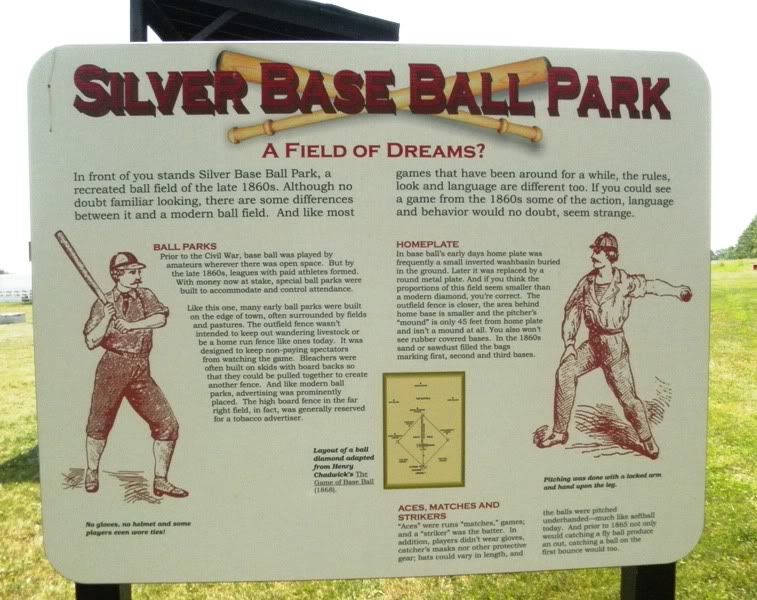
Here is the sign that greets folks as they walk in.  It explains a bit about 19th century base ball and shows the layout of the diamond.  And, yes, there were folk who played wearing ties.  Don't ask - I have no idea what would have been going through their heads!

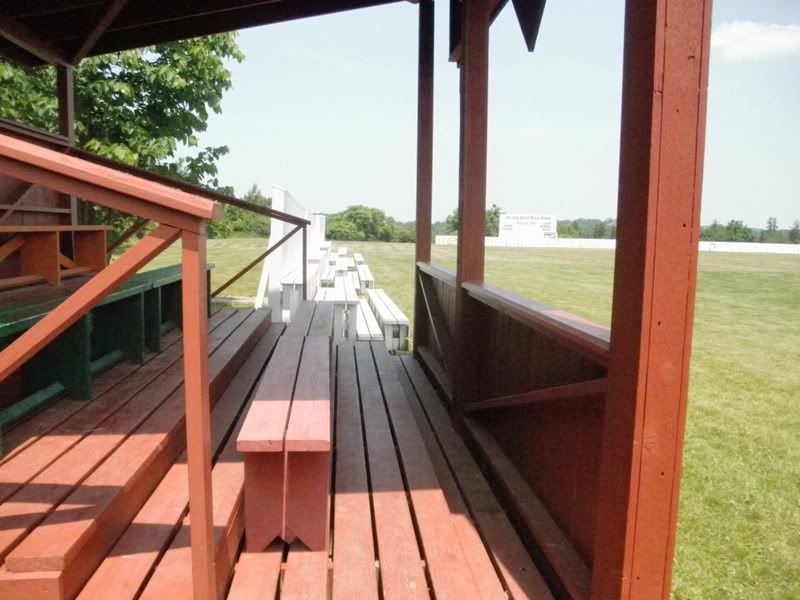
And here is the obligatory artsy shot, this one is looking through the box seats down the 3rd base line including the bleachers. 


Yes, it's a field.  Very definitely!


I decided to take shots from the pitcher's mound.  From my vantage point, the pitcher's mound didn't seem very high.  But all is relative, I suppose!


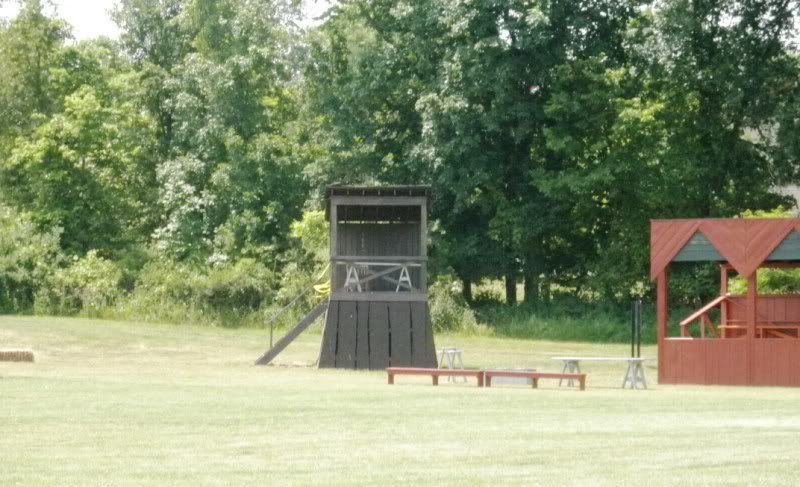
This is the box where the referees sat.  To the right are the bleachers and box that I showed in the first picture.  To the left is the whatchamacallit - the backstop, maybe?  The red bench in between the ref's box and the covered bleachers is the team bench.


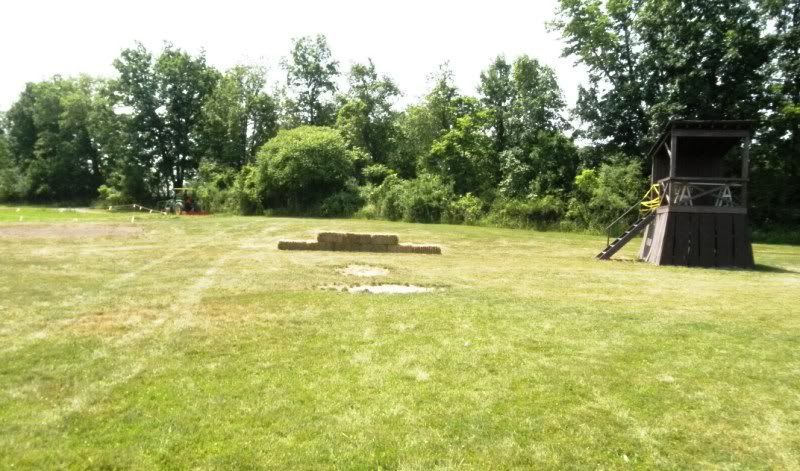
I've stepped back away from the mound to get a shot of the entire backstop.  And whoever said hay bales were just for storing sileage?  Not I!!!!


This is the scoreboard.  When a game is being played, one or two young people change the information as it mounts up.  I think it's pretty neat (but that's just me).


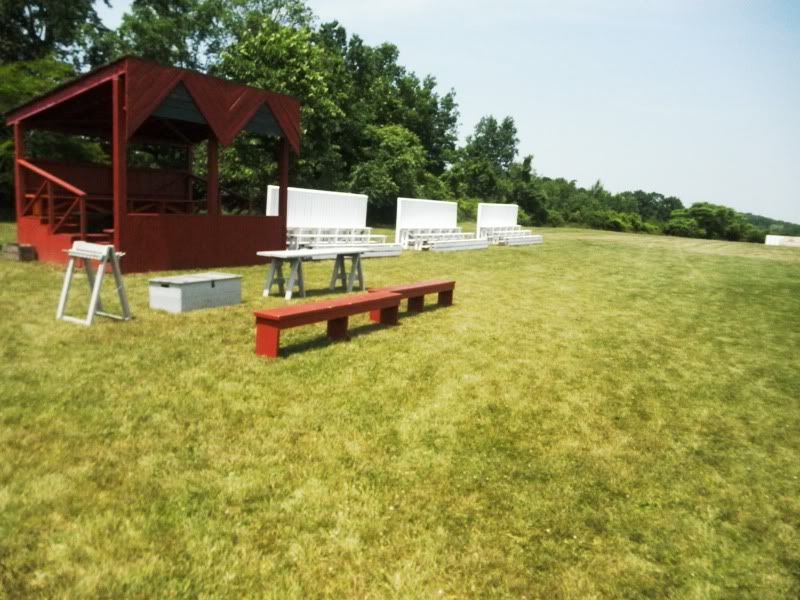
This is a better look at the players' bench.  The box behind the bench carries the team's equipment.  The table on the sawhorses could have been used for water buckets or perhaps to take a look at an injured player...I'm not sure.  But the stand on the near side of the bench held the bats during the game.  (Can you tell I'm not really a huge base ball fan?  But I am a huge fan of the history of things!)


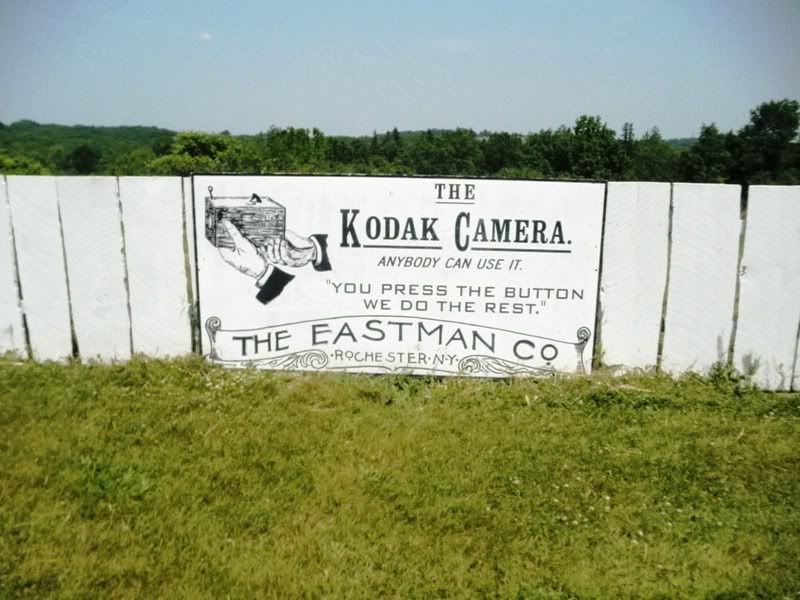
There were ads on the fence, of course (ads have been on things since people have built buildings and decided to do exterior decorating!).  The camera that this ad is talking about (just for grins and giggle) is a very early Kodak camera, before the Brownie.  In Kodak's first years, one purchased the camera loaded with film.  When the film was used up, the entire entity, camera, film and all was returned to Kodak.  The camera was reloaded and sent back to its owner.  I know that sounds rather odd, but some years were to pass before the film came in a format that the customer could handle without damaging the negatives.


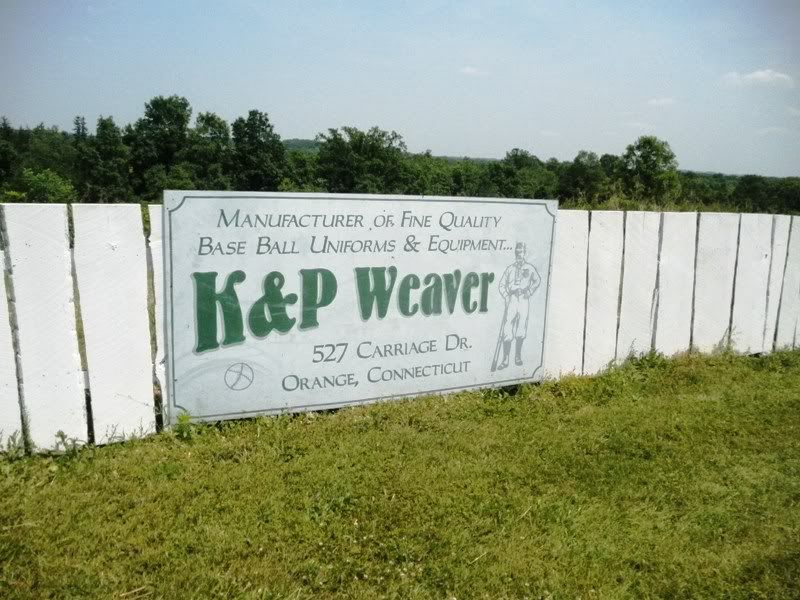
There was a Wendy's sign as well, but, although the format was distinctly 19th century (no little Pippi Longstocking look-alike).  I decided, instead, to show this sign.  Again, it is definitely the way a sign would have looked in the 19th century, but it's modern.  I believe that K&P Weaver is the company that makes the old fashioned uniforms used by heritage teams.

It's a field, there are no line strips and I couldn't figure out where the bases were (although, since today is the first day of the season, perhaps the team hadn't put out whatever markers it uses for the bases),  and the players are going to be warmer than the weather even before they start playing.  But the game will be a base ball (baseball) game like any other, right down to this day.  There will be hawkers vending their wares, homeruns will be hit and everyone will have a great time! 

OH, one other picture - and this is a part of history that isn't as well known, I think.

There is a women's 19th century base ball team at the Museum.  I am just back from doing some research because I wasn't aware that women DID play ball in the 1800s.  However,they most certainly did. 
As you might expect, women played out of the public eye for the most part in the early years: playing base ball, like the acting in the theatre, was viewed as marginally acceptable by the public. But play they did.

Here's a URL for more information about that time frame.  It's from the Historical Society of Pennsylvania.

http://www.hsp.org/node/2934

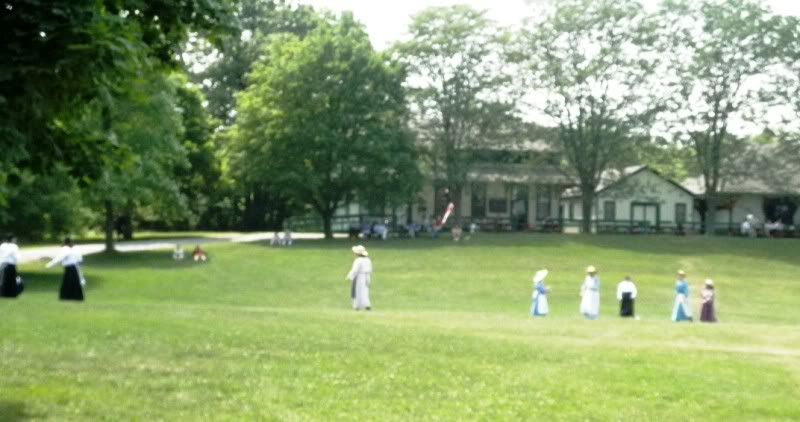
Yesterday, they were playing on the Great Meadow (where the bandstand is) at the Museum.  And their excitement over the game was contagious.  This is a long shot, but I wanted to get a picture of the ladies in as well.


I wish I could have gone to the double header today, but at least I got a chance to see the field and to take some pictures!  I hope you liked what I did!

Have a great day!